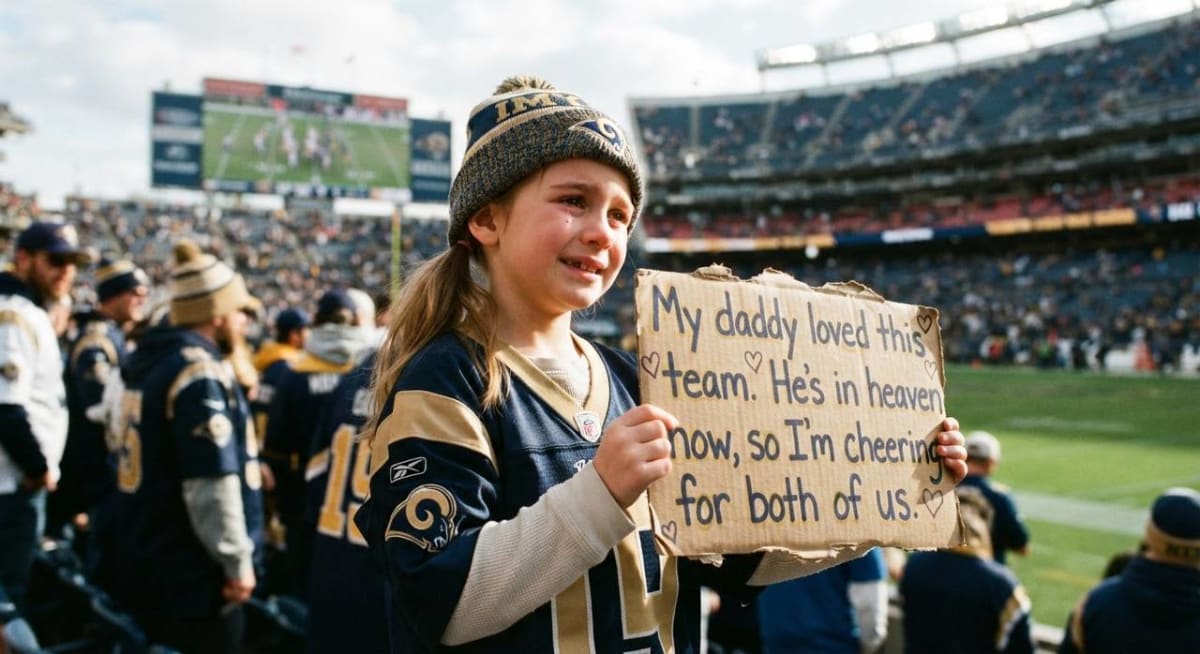
After my husband died, my eight-year-old daughter stopped caring about the football team the two of them used to watch together every week. So when she finally asked to go to a game, I spent months saving up to make it happen. I honestly thought the hardest part of that day would just be getting through it without him.
The Two of Them and Their Sunday Ritual
My daughter Kelly learned football sitting on the couch next to her dad. I never cared much for the sport myself — but Austin cared enough for all three of us combined. By the time she was seven, she could rattle off positions, penalties, coaches, half the roster in the league.
Every Sunday, our living room turned into his classroom.
"Okay," he'd say, pointing at the TV. "What does the safety do?"
Six-year-old Kelly would squint hard at the screen. "Stops people from being... safe?"
He'd crack up every time. "Close enough for today."
She also figured out fast exactly when she could work him.
"Dad, the game's not even over."
"It's bedtime, kiddo."
"But you said fourth quarters build character."
Twenty more minutes, every single time.
"I absolutely did not say that," he'd tell me later, looking almost guilty about it.
"You probably did," I'd say.
Kelly would just grin like she'd won something. Sometimes she'd correct him mid-sentence before he even finished explaining a play. Football was theirs. I sat on the other end of the couch and pretended to follow whatever they were yelling about.
Then last year, Austin was killed in a car accident. He kissed me goodbye that morning, reminded Kelly to finish her spelling homework before school. By that afternoon there was a police officer standing at our front door.
The Quiet After
For months, the house just went quiet in a way I still can't fully describe. Kelly stopped asking to watch football at all. Austin's team jersey stayed exactly where he'd left it, folded over the back of his chair. I kept bracing for noise that never came from the rooms it used to come from.
Every Sunday she still sat beside me on the couch out of habit, except now she stared at the empty cushion where he used to be. Neither of us moved the jersey. It just... stayed.
Then, about six months after the accident, she wandered into the kitchen while I was making lunch.
"Mom? Do you know what time the game starts?"
I turned around so fast I nearly dropped what I was holding. "What game?"
She gave me a look so much like her father's that it actually knocked the wind out of me. "Dad's team."
I checked my phone. "Four thirty."
"Can we watch?"
I just nodded, trying hard not to make a big deal out of it. She walked into the living room, picked Austin's jersey off the chair, and put it on. It hung down almost to her knees. That was the first Sunday football came back into our house. She kept watching every week after that, even through the losses that clearly stung.
Getting to the Game
For Kelly's eighth birthday I wanted to do something that actually mattered. Money had been tight since Austin died, but I'd been setting a little aside whenever I could manage it, and eventually I had enough for two tickets. Nothing special — not the best seats, not the worst either.
When I showed her, she screamed, then immediately accused me of printing fake tickets just to mess with her. Once she realized they were real, she threw herself into my arms.
"Dad always said we'd go," she said into my shoulder.
She slept with those tickets on her nightstand that night.
The evening before the game, she disappeared into her room with markers and a poster board and didn't come out for an hour. When she finally did, she was holding up a sign in crooked blue letters:
MY DADDY LOVED THIS TEAM. HE'S IN HEAVEN NOW, SO I'M CHEERING FOR BOTH OF US.
I had to turn away for a second so she wouldn't see my face.
"Is it bad?" she asked, frowning.
"No — it's good. That's why I'm crying."
She smiled and told me she was definitely bringing it tomorrow. I folded it carefully that night so the letters wouldn't crack.
Game Day
She carried that sign through the stadium like it was made of glass, and people noticed. A guy near the concession stand gave her a thumbs-up. Someone else read it and said quietly, "Sorry about your dad, kiddo." Kelly had the same answer ready every time: "Thanks. He would've loved this."
Our seats were close enough to watch warmups. Kelly narrated the whole thing.
"That's Marcus. Mom, he's Dad's favorite player."
"I know that."
"No, you don't."
Marcus was a longtime receiver — Austin had owned his jersey and spent an unreasonable amount of energy defending him through every rough season. Kelly knew every single warmup drill by name before I'd figured out what was even happening on the field.
She stood by the railing holding her sign up. Marcus jogged past, glanced over, and stopped. He read it once. Then again. Then he pointed straight at her.
Kelly went completely silent. "He's... pointing at me."
"I see that too."
He picked up a football and tossed it in her direction. A few adults nearby reached for it on reflex, but someone behind us shouted, "It's for the kid!" — and it landed right in her arms.
For one full second she didn't make a sound. Then she screamed, laughing and crying at the same time.
"Mom, look! He would've told everyone he caught it himself!"
I was laughing through tears right along with her. "He absolutely would have."
The Woman in the Next Row
Kelly was still hugging the ball to her chest when a hand reached across me and snatched it right out of her arms. A woman sitting beside us had grabbed it and was already handing it to the teenage boy next to her.
Kelly gasped. I just stared at her.
"He's been playing football for three years," the woman said, adjusting her coat like that settled it. "My son should have it."
I genuinely thought I'd misheard her. "That player threw the ball to my daughter."
"He threw it into the crowd. Ethan has just as much right to it as anyone."
"He pointed at her first." I could feel Kelly's tears welling up beside me, and something in me went cold and still.
"So?" the woman said.
"Give my daughter her football back."
She actually laughed. "Girls don't understand football. My son deserves it more."
"Why would you say that to her?"
Then she looked at Kelly's sign, glanced at her tear-streaked face, and said something I still can't believe came out of an adult's mouth toward a grieving eight-year-old: "It's not like it really matters. She'll forget about it by tomorrow. Buy her a doll or something."
Her son looked like he wanted the ground to swallow him. A man in the row behind us muttered, "Lady, seriously?" She didn't even flinch.
I held my hand out again, and that's when the section behind us started shouting — not at her. Toward the field.
Everyone Saw It
I turned around. Marcus was staring straight at our section, and he wasn't smiling anymore. He pointed at Kelly, then at the football sitting in Ethan's hands. A staffer on the sideline followed where he was pointing, and a second later Marcus had a microphone in his hand.
The noise in the stadium dropped by half.
"I threw that ball to the little girl holding the sign," he said. "The young man holding it right now knows exactly who it belongs to."
Kelly grabbed my hand and squeezed so hard it actually hurt. Then the jumbotron switched over — and there we all were, ten feet tall on the screen. Kelly. Me. The woman. Ethan, frozen with the ball still in his hands.
His mother's mouth snapped shut. "Ethan," she said under her breath.
He looked up at the screen, then at Kelly, and didn't move.
An usher and a security guard showed up at the end of our row within seconds. The woman spun toward me. "She's been harassing me."
"Lady," the guy behind us said, laughing in disbelief, "the whole stadium just heard him say it."
The security officer looked at Ethan. His mother started, "It went into the crowd, and he—"
"Stop," Ethan said. Just that. His mother's face changed completely.
"I was trying to help you," she said. "He threw it to her. I didn't ask you to grab it." "You said you wanted a game ball." "Not hers."
He walked over and held the football out to Kelly. She hesitated before taking it back.
"It's okay," she told him.
He shook his head. "No, it isn't." His mother's face went red. The screen cut back to the warmup feed, and Marcus gave Ethan a small nod from the field before jogging off toward the tunnel.
What Happened in the Tunnel
An usher bent down toward me a few minutes later. "Would you and your daughter mind staying put for a second? Someone asked to see her after warmups."
Kelly's eyes went huge. "Am I in trouble?"
"No," I said. "I'm kidding — no, you're not."
We followed him down a concrete hallway near the tunnel, Kelly hugging the football the entire walk. A door opened, and Marcus was standing there. Kelly stopped dead and half-hid behind my leg.
He crouched down to her height. "Hey. I saw your sign. What was your dad's name?"
"Austin," she said, barely above a whisper.
"Sounds like Austin knew what he was doing," Marcus said, once Kelly told him her dad had taught her everything she knew about the game, "because Mom sure doesn't understand penalties."
I gave her a look. Marcus laughed.
He pulled a marker out of his pocket. "Usually I just sign my name, but—" He looked at me. "How do you spell Austin?"
My throat closed up. He wrote it beneath his signature and handed the ball back to her.
For Kelly and Austin — keep cheering together.
She traced the letters of her dad's name with her finger, twice, before pulling the ball back into her chest and starting to cry — full eight-year-old, shoulder-shaking crying. Marcus looked briefly panicked until she managed to get out, "Good tears," between sobs.
"Actually," he said once she'd calmed down, "if it's okay with Mom, I've got one more question — you want to stand by the tunnel for introductions?"
Her mouth fell open. "Mom!"
"I already said yes," I told her, laughing.
After the Game
When the team ran out for introductions, Kelly screamed loud enough that I thought she might actually lose her voice by the end of the day. She held that signed football against her chest through the entire game. For a little while, she wasn't crying because she missed her dad — she was crying because something good had actually happened to her.
On our way out afterward, we passed Ethan standing several feet from his mother. He lifted a hand. "Hey. I should've given it back right away."
"I know," Kelly said, hugging the ball a little tighter. "But I probably would've hesitated too."
He almost smiled. "I hope the rest of your day goes smoother." Then we just kept walking. That was enough.
Sundays Now
That night Kelly set the football down on the coffee table, right next to where she'd draped Austin's jersey over his old chair, and just sat there looking at both of them for a while.
"Dad would've been so jealous," she said eventually.
"Extremely."
"He would've touched the ball way too much and gotten his prints all over it."
I laughed. Then she went quiet and asked, "Mom? Do you think Dad saw? The game, the sign, all of it?"
"I hope so," I told her. "So do I."
A few weeks later she wrote Marcus a thank-you letter and added one line at the very bottom: The ball is next to my dad's jersey now. I think he'd like that.
Sunday football feels different now, and I think it probably always will. Austin's chair is still there. Kelly still drapes his jersey over it before kickoff, and the signed ball never moves off that coffee table.
Last week I sat down next to her instead of at the far end of the couch, and she looked at me like I'd interrupted something important.
"Dad would've already explained this play to you," she said.
"I'm comfortable right here."
She patted the cushion anyway and pointed at the screen. "Fine. Watch the safety."
"The guy who stops people from being safe?" I said, and she stared at me for a second before cracking up.
"That was when I was six, Mom. That is not what a safety does."
"Then educate me," I told her.
So she did — started walking me through coverage and routes like she'd been doing it her whole life, and I realized halfway through that she was teaching me exactly the way he used to teach her. I understood maybe half of what she said. I watched her face the whole time instead.
I glanced once at Austin's empty chair, then back at her. For the first time since he died, that empty space wasn't the only thing I could see anymore.