Some people spend their entire lives chasing money, status, and possessions, believing that these things will eventually bring them happiness. Others have almost nothing and yet somehow manage to give more kindness than those who own everything. Sometimes, the smallest gestures reveal the biggest hearts, and sometimes, the people we least expect become the most important characters in our lives.
I learned this lesson through a young homeless man named Ethan, a person my family initially saw as a stranger with nothing to offer. He had no permanent address, no savings, and no family willing to take him in. Everything he owned fit inside a worn backpack. Yet, in the final years of my mother's life, he gave her something that money could never buy: companionship, attention, and the feeling that she still mattered to someone.
What happened after my 90-year-old mother passed away changed the way I understood generosity, family, and the true meaning of inheritance. It also revealed a side of my brother that I had never fully wanted to acknowledge.
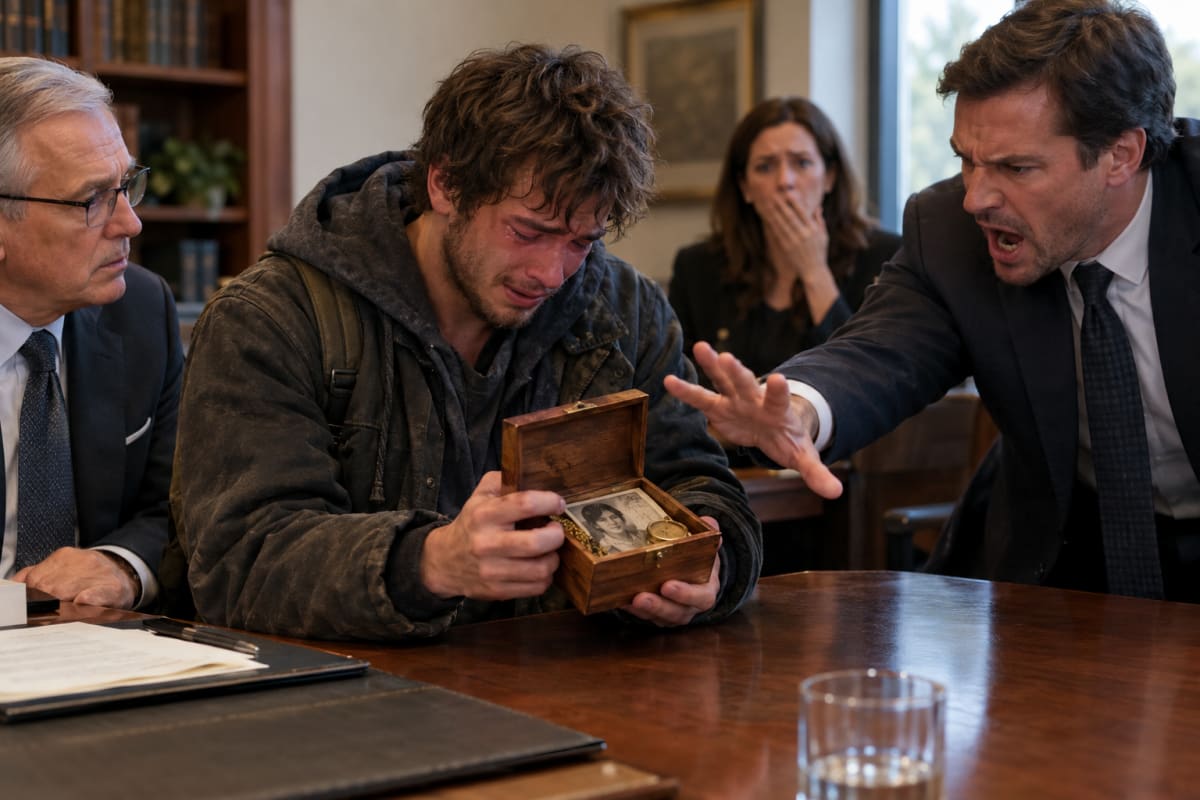
But to understand why a small wooden box caused such an extraordinary reaction at a lawyer's office, you need to understand how an unlikely friendship began.
The Day My Mother Met Ethan
My mother was 90 years old when she died. She had been widowed for many years, and although she had children, grandchildren, and a comfortable home, the final chapter of her life was often much quieter than anyone wanted to admit.
My father had passed away long before, leaving behind a house filled with memories, photographs, and familiar objects that had barely moved in decades. Mom continued living in the same home because she believed that leaving it would mean abandoning a part of the life she and my father had built together.
She kept his favorite chair near the window. His old books remained on a shelf in the study. Sometimes, when I visited, I would find her looking at a photograph of the two of them taken when they were young.
She rarely complained about being alone. That was simply the kind of woman she was. She had spent most of her life taking care of other people, and she never wanted her children to feel guilty for having their own responsibilities.
But I knew loneliness had slowly become part of her daily routine.
My brother and I visited when we could, although our schedules were often busy. We called regularly, helped with practical matters, and made sure she had what she needed. We believed we were doing our best.
Then, one ordinary afternoon outside a pharmacy, Mom met a young man who would gradually become one of the most important people in her life.
His name was Ethan. He was only 25 years old.
He was homeless, slept behind a closed bookstore, and carried everything he owned in a single backpack. His clothes were worn, his shoes were damaged, and he looked like someone who had spent too many nights outside.
That day, Mom had been struggling to carry her groceries. One of the bags slipped from her hand, and several items fell onto the pavement.
Before anyone else could react, Ethan stepped forward.
He picked up the groceries, checked that nothing had broken, and offered to carry the bags to her car.
Mom thanked him and tried to give him a little money for helping her.
He refused.
According to what she later told me, he simply smiled and said, "It's okay, ma'am. You looked like you could use a hand."
That might have been the end of the encounter. Most people would have continued with their day, forgetting the face of a stranger they had helped for a few minutes.
But Mom remembered him.
She noticed how carefully he handled her groceries and how he waited until she was safely inside her car before walking away. She also noticed that he seemed exhausted, although he never complained about his own situation.
Something about the young man stayed with her.
A few days later, she returned to the pharmacy and happened to see him nearby.
She greeted him, asked how he was doing, and learned that his circumstances had not improved. He had no stable place to live and no reliable source of income.
Mom did not treat him like a problem to be solved or someone to be pitied.
She treated him like a person.
She asked whether he had eaten that day and offered to buy him lunch.
Ethan hesitated before accepting.
That simple lunch became the beginning of a friendship neither of them could have predicted.
The Young Man Who Returned Every Thursday
After their first meeting, Ethan began visiting Mom regularly.
At first, he stopped by occasionally to see whether she needed help carrying groceries or moving something around the house. Eventually, those visits became a routine.
Every Thursday, he would appear at her door.
Sometimes he brought a small loaf of bread. Sometimes he had nothing to offer except his time. He helped her carry shopping bags, swept leaves from the front steps, and repaired loose boards on the porch.
He also listened.
That was something Mom had been missing for years.
Ethan would sit with her while she talked about my father, her childhood, the difficult years when our family had little money, and the small moments that had made her happiest.
She told him stories about the first house she and my father rented. She described their early arguments, the way he used to sing while cooking, and how he once drove across town in the middle of the night because she had mentioned wanting a particular dessert.
Ethan listened as if every detail mattered.
He never checked his phone or looked toward the door as though he were waiting for an excuse to leave. He did not interrupt her stories or tell her that she had already shared them.
Sometimes she repeated the same memory several times.
He listened every time.
For a woman who had spent decades being the person everyone else depended on, that kind of attention meant more than I initially understood.
As the weeks passed, Mom began looking forward to Thursdays.
She would wake up early, prepare tea, and sometimes bake something small because she expected Ethan to visit. If he arrived late, she would glance toward the window and wonder whether something had happened.
She never described him as a charity case.
She called him her friend.
That distinction mattered.
People often assume that those who have little must always be on the receiving end of generosity. They forget that a person without money can still offer companionship, loyalty, patience, humor, and genuine affection.
Ethan had very little in material terms, but he gave my mother something she had struggled to find elsewhere: the feeling that someone was genuinely interested in her life.
And in return, she gave him something he had been missing, too.
For a few hours every week, he had a place where he was welcomed rather than merely tolerated.
He could sit at a kitchen table without being asked to explain himself. He could talk about his day without feeling embarrassed. He could enjoy a warm meal without worrying about where he would sleep that night.
Their friendship gradually became a source of comfort for both of them.
Neither seemed concerned about the difference in their ages or circumstances.
They simply enjoyed each other's company.
The Birthday Gift That Cost Him Almost Everything
The moment that truly revealed Ethan's character came on Mom's 80th birthday.
She had never been particularly interested in extravagant celebrations. She preferred quiet afternoons, familiar faces, and the simple pleasure of sharing food with people she loved.
That year, I arranged a small gathering. There was cake, tea, and a few family members sitting around the dining table.
Ethan arrived later than expected.
He stood at the front door holding a modest bouquet of yellow roses.
They were not the most expensive flowers in the shop. The wrapping was simple, and a few petals had already begun to bend. But he held them carefully, almost as if he were carrying something priceless.
Mom's face changed the moment she saw him.
She smiled in a way I had not seen for a long time.
"Oh, Ethan," she said, taking the flowers from his hands. "You didn't have to do this."
He shrugged, looking slightly embarrassed.
"Happy birthday," he replied.
She placed the roses in a vase and kept them on the dining table for the rest of the celebration.
Later, after everyone had left, I learned something that made the gesture even more meaningful.
Ethan had spent his last $12 on those flowers.
He had only a little money left, and he had chosen to use it to make an elderly woman happy.
He could have bought himself food. He could have saved the money for transportation or another immediate necessity. He could have decided that a bouquet was an unnecessary expense when he had no permanent home.
Instead, he bought flowers.
When I asked him why he would spend his final money on something that would eventually wilt, his answer was so simple that I remembered it years later.
"Because she deserves flowers on her birthday."
He did not say that he wanted recognition. He did not mention how difficult his life had become. He did not ask whether my mother could help him in return.
He believed that she deserved to feel special, and he acted on that belief.
I remember looking at him and wondering how someone who had so little could be so thoughtful.
My family had more financial security than Ethan could have imagined. We could afford gifts, dinners, and comfortable homes. Yet none of us had thought to buy Mom flowers with quite the same meaning behind them.
Ethan had not purchased a luxury.
He had given her a moment of happiness at a time when loneliness had become increasingly familiar.
That bouquet eventually faded, as flowers always do.
But the gesture remained.
Mom spoke about those yellow roses for months. She told anyone who would listen that Ethan had remembered her birthday and brought her something beautiful.
And every time she mentioned it, she seemed a little younger.
A Friendship My Family Did Not Fully Understand
As Ethan became a regular presence in Mom's life, I began noticing how deeply attached she had grown to him.
She spoke about him frequently. She worried about whether he was eating properly. If the weather turned cold, she wondered whether he had found somewhere warm to sleep.
Sometimes she asked me to bring him an extra coat or a pair of gloves.
I never objected to helping him, but I did not immediately understand why their friendship had become so important to her.
My brother understood it even less.
He was more concerned about practical matters. He worried that Mom was becoming too trusting and that someone might take advantage of her kindness.
His concerns were not entirely unreasonable. An elderly person can be vulnerable to manipulation, and financial or emotional exploitation is a genuine risk.
But there was a difference between protecting Mom and dismissing every person who entered her life without money or social standing.
Ethan had never asked her for a large sum of money. He had never demanded that she support him. He had never pressured her to change her will or give him ownership of anything.
He showed up, helped with ordinary tasks, and listened.
Over time, Mom became more confident around him. She laughed more often during his visits. She told stories that she had not shared in years. She seemed less trapped by the quietness of her house.
One afternoon, I found them sitting on the porch.
Mom was holding a cup of tea, and Ethan was repairing a loose section of the wooden railing.
She was telling him about my father again.
When she finished, Ethan put down his tools and said, "It sounds like he really loved you."
Mom looked at him for a long moment.
"He did," she replied. "And I was lucky enough to know it."
I stood nearby, listening, and suddenly understood something I had overlooked.
Ethan was not trying to replace my father, nor was he trying to become part of our family for financial reasons.
He was giving Mom a safe place to remember the person she had lost.
Sometimes, that is what people need most as they grow older: not advice, not solutions, and not expensive gifts, but someone who is willing to sit beside them and listen.
Still, nothing prepared me for what Mom eventually told me.
The Question That Left Me Speechless
One afternoon, Mom asked me to sit with her in the living room.
She had been unusually quiet that day, and I assumed she wanted to discuss a medical appointment or something related to the house.
Instead, she looked directly at me and said something I never expected to hear.
"I asked Ethan to marry me."
For a moment, I thought I had misunderstood her.
"What?"
She repeated herself calmly.
"I asked Ethan if he would marry me."
I stared at her.
Mom was 80 years old. Ethan was 25.
The difference between them was 55 years.
I struggled to understand why she would make such a request, and my first reaction was a mixture of confusion and alarm.
"Mom, he's 56 years younger than you!" I exclaimed.
She did not become angry. She did not try to defend herself by pretending the age difference was insignificant.
Instead, she looked down at her hands.
"I know," she said quietly.
"Then why would you ask him something like that?"
She took a breath before answering.
"I wanted him to have a home. I wanted him to have someone who cares about him. I wanted him to know that he doesn't have to face the world alone."
Her explanation caught me off guard.
I had expected her to describe romantic feelings or an unusual attachment. Instead, she spoke about security, belonging, and the possibility of giving someone a permanent place in her life.
She knew Ethan was homeless. She knew he had very little support. She had seen how carefully he treated others, even when he was struggling himself.
She wanted to offer him something lasting.
But marriage was an extraordinary way to express that wish, and I worried about what it meant for both of them.
"Did he agree?" I asked.
Mom shook her head.
"No."
For some reason, that answer surprised me almost as much as the original revelation.
I asked what Ethan had said.
According to Mom, he had listened to her carefully before refusing.
He told her that he could not marry her simply to escape homelessness.
He would not accept such a commitment because he needed a place to sleep. He would not allow her generosity to become an obligation that he could not honestly fulfill.
He respected her too much to pretend that he could offer the kind of marriage she had proposed.
That response changed how I saw him.
A person desperate for shelter might have accepted the offer without considering the consequences. Ethan, however, refused to turn Mom's affection into an opportunity for personal security.
He could have gained a home and potentially much more.
Instead, he chose honesty.
Mom told me that she understood his decision, even though she was disappointed.
She never forced the issue. Their friendship continued, and Ethan kept visiting every Thursday.
They returned to their ordinary routine of tea, stories, groceries, and small repairs.
But something had changed in my understanding of their relationship.
It was not about the money he lacked or the things she could give him.
It was about the trust they had built.
And that trust would soon become more important than either of us could have imagined.
The Last Thursday
Three months after their conversation about marriage, Mom passed away peacefully in her sleep.
There was no dramatic final scene. No warning that gave us time to prepare ourselves emotionally.
One day, she was still the woman who kept my father's photographs near the window and waited for Ethan's Thursday visits.
Then she was gone.
Even when someone reaches the age of 90, losing them leaves a space that no amount of preparation can completely fill.
The house felt different immediately.
The kitchen was still there. The cups were still arranged in the cabinet. My father's chair remained beside the window, and the photographs on the shelves showed the same familiar faces.
Yet everything seemed quieter.
I kept expecting to hear Mom calling from another room or asking whether I wanted tea.
For the first few days, my brother and I focused on practical arrangements. We contacted relatives, organized the funeral, and began dealing with the documents that follow a death.
It was difficult to enter her bedroom.
Her belongings were arranged exactly as she had left them. A folded sweater rested on a chair. A small notebook lay beside her bed. There were photographs of my father, old letters, and a few sentimental objects she had kept for decades.
As I went through her things, memories surfaced unexpectedly.
A scarf reminded me of a winter holiday. A handwritten recipe brought back a family dinner. A small vase made me think of the yellow roses Ethan had brought for her birthday.
I wondered whether he had already heard the news.
I knew how much their Thursday visits meant to him, and I imagined how strange it would feel for him to return to the house and discover that the person who had welcomed him was no longer there.
Then I found a handwritten note.
It was tucked among Mom's personal papers.
The handwriting was unmistakably hers.
At first, I thought it might be a list of instructions or a reminder about something she wanted us to do. But as I read the words, I realized that she had left a very specific request.
She wanted Ethan to be invited to the reading of her will.
I read the note twice.
Why had she made that request?
Had she left him money? Was there something she wanted him to receive? Had she written a letter that she wanted him to read after her death?
I did not know.
But I understood that the request mattered to her.
Mom had taken the time to write it down. She had wanted to make sure that Ethan would be present when her final wishes were read.
I decided that I would honor that request, regardless of what my brother thought.
I had no idea how strongly he would react.
Finding Ethan Again
Tracking Ethan down was not easy.
He did not have a permanent address, and he did not own a phone that was always available. The places where he stayed could change depending on the weather, the availability of shelter