I thought I knew everything about the little girl I had raised as my own. But on her wedding night, a stranger emerged from the crowd with a secret that could shake everything I believed.
My name is Caleb. I am 55 years old, and more than 30 years ago, I lost my wife and young daughter in a single night that brought my world crashing down.
There was a car accident — a phone call. A calm but cold voice on the other end of the line told me there had been an accident, and then they were both gone.
Mary, my wife, and Emma, our six-year-old daughter.
I remember standing in the kitchen, holding the phone, staring blankly into space.
I could hear the silence — not just when I slept, but also in the pauses between my thoughts.
For years, I drifted through life without truly living. I woke up, went to work, came home, and heated frozen dinners that I ate in front of the TV without really tasting them.
Friends tried to check on me. My older sister called every Sunday. But none of it mattered.
The house was still empty.
I kept pictures of Emma on the refrigerator until they turned yellow, going through empty days with a broken heart. I couldn't bring myself to throw them away.
I never thought I would be a father again. That part of me was buried. I had done it once — and failed to keep them safe.
But life does strange things when we stop expecting anything from it.
One rainy afternoon, years later, I pulled into the parking lot of an orphanage. I told myself I was just curious. I wasn't committing to anything. I wasn't looking for a replacement.
But something inside me — perhaps a whisper from the man I used to be — wanted to see if I could still make a difference, even though I wasn't sure what I was looking for.
Inside the orphanage, the air smelled of bleach and crayons.
Laughter echoed down a hallway, and I heard someone calming a tantrum behind a closed door.
I met a social worker named Deirdre, who explained the basics of the process.
She was patient and honest, and she didn't hide anything.
Then we walked past a large window overlooking a small playground, and I saw her.
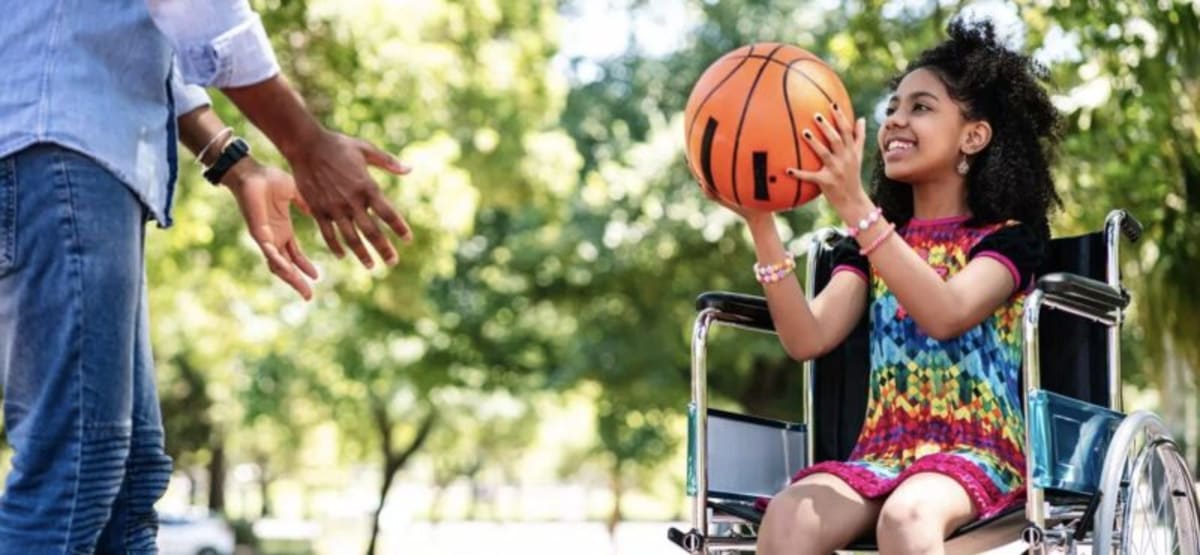
She sat quietly in a wheelchair. Her hair was neatly tied back in a ponytail, and she held a notebook in her lap.
While the other children ran around and chased one another, she simply watched them. Her face was calm — too calm for someone her age.
"That's Lily," Deirdre said softly beside me, noticing where I was looking.
She was five years old and had been living there for a long time.
I asked why she was in a wheelchair.
"A car accident," she said. "Her father died in the accident. Her spinal cord was injured — an incomplete injury. With therapy, she could improve. But she has a very long road ahead of her."
"And her mother?"
There was a pause.
"She gave up custody not long afterward. She said she couldn't handle the medical needs. Or the grief."
Something stirred inside me.
I looked at Lily again. And as if she sensed we were talking about her, she turned and looked at me.
Our eyes met.
She didn't flinch or look away. She simply sat there, watching me like someone watching a door — wondering whether it would open or close again, just like all the others.
Something inside me broke.
I didn't see a diagnosis or a burden. I saw a child who had been abandoned — and was still quietly waiting for someone who wouldn't leave her.
Even Lily had facial features that reminded me of my late daughter.
Deirdre explained that no one wanted to adopt her. My heart tightened, and somehow, we connected.
I knew she was the child I wanted to adopt — the one who truly needed my love.
I asked to begin the adoption process immediately, which surprised the social worker.
There were background checks, interviews, and home inspections.
I returned to the orphanage often to visit Lily. We talked about animals and books. She showed me her drawings. She especially loved owls — "because they can see everything," she said.
That struck a chord with me. She had already seen too much.
When I finally brought her home, all she had with her was a worn-out backpack, a faded little stuffed owl, and a notebook full of sketches.
I showed her her bedroom and let her adjust to the space.
Lily didn't say much during the first few days, but she kept watching me with her eyes — as if she were still deciding whether this was real.
One evening, while I was folding laundry in the living room, she came in from the hallway and said, "Dad, can I have some more juice?"
I dropped the towel!
That was the first time she had called me "Dad"!
From that moment on, we became a team. Lily's therapy became part of our routine. I cheered her on through every little step — the first time she stood for 10 seconds without support, and the day she took five steps with her braces!
She worked hard and had incredible determination.
School brought its own challenges.
Some children didn't know how to treat her. But Lily wasn't one to dwell on things. She learned quickly and made friends little by little. She became fiercely independent, refused to be pitied, and hated it when people treated her as if she were fragile.
We built a life together. She became my world.
The years passed.
She grew into an intelligent, warm, confident, stubborn, but kind-hearted young woman.
Lily loved science and wanted to study biology.
She even worked at a wildlife rehabilitation center one summer and helped care for an injured barn owl. She named him Harold and cried the day they released him back into the wild.
When she was 25, she met Ethan at college. He was studying engineering and had a goofy laugh and an easy smile. He absolutely adored her.
She gave him a hard time at first — she liked to test people — but he passed every one of her silent tests.
When they got engaged, she told me over breakfast as if it were nothing special. I nearly choked on my toast!
The wedding we planned, 23 years after I adopted her, was small but beautiful.
She wore a white satin dress that hugged her shoulders and flowed as though it had been made just for her.
The venue was a small hall not far from where we lived, decorated with soft twinkling lights and white lilies on every table.
I watched her smile, laugh, and dance confidently with Ethan, surrounded by people who had witnessed her growing up. People who had stayed.
My chest felt as though it might burst with pride!
While everyone was dancing, that's when I saw her.
A woman I didn't recognize stood near the exit. She was in her late 40s, with dark hair neatly tied back.
She had just entered the hall and seemed to be looking for someone. I assumed she was a guest from the groom's side.
I noticed that she was watching Lily, not the crowd. And she looked as though she didn't belong — as if she knew she shouldn't be there.
I was about to approach her and offer help, but she suddenly looked at me. Our eyes met, and she quickly lowered her gaze. Then she began walking slowly toward me, weaving between the guests while keeping to the side.
She sighed when she reached me and quietly said, "I know we don't know each other, but you need to listen to me," without introducing herself. "Can we talk in private?"
Although I was suspicious, I stepped aside and gestured for her to follow me to a quieter corner near the window, away from the tables.
"You don't know what your daughter has been hiding from you," she said, her voice trembling. "For a long time."
My stomach tightened. I looked at Lily, who was laughing with her best friend and Ethan's younger sister, completely unaware of what was happening.
"I'm her biological mother," the woman added.
The room seemed to grow quieter.
She continued, "Something terrible happened in her past, and you need to know the whole truth."
"She found me two years ago," the woman said. "She looked for me after college. The orphanage still had some of my contact information in her records, and she persuaded them to give it to her."
I stood there in silence.
"She contacted me," the woman said. "She asked a lot of questions. I explained why I left. I explained everything."
"Everything?" I asked.
"Yes, listen, I was young. I was scared. After the accident, I didn't know how to care for a disabled child. Everyone kept looking at me as if I were a monster, or as if they pitied me. I couldn't do it."
"So you simply walked away," I said.
"I thought it was the best thing to do," she replied. "Better than dragging her down with me."
I slowly exhaled.
"She stopped replying to my messages a few months ago. She said she wanted nothing more to do with me. But before that, she casually mentioned her wedding. She told me it would be held here."
"Why are you telling me this now?"
"Because you deserve to know," she said. "And I'm her mother, so I have a right to be part of her life."
I nodded slowly.
"I carried her for nine months," she said.
"But I've been the one taking care of her all this time," I replied.
The woman was taken aback.
"She built her life without you, learned to walk again, went to college, and found love. All of that without your help."
Her eyes began to fill with tears, but I didn't stop.
"Today is about the people who stayed. You had your chance. You let her go."
There was a long silence.
Then I added, "I think it's time for you to leave."
The woman didn't argue. She simply turned and walked away the same way she had come — quietly, unnoticed.
That night, after the crowd began to thin and the music softened, Lily and I found a moment to talk alone in the backyard. The air was cool and still. She leaned against the railing and gazed out into the quiet night.
Then I said, "I want you to know something."
She looked at me, already guessing.
"She came, didn't she?" Lily asked.
I didn't lie.
"She came."
"I'm sorry I didn't tell you I'd found her," she said. "I was afraid it would hurt you. Maybe you'd think you weren't enough."
I looked at her.
"Lily, you don't have to protect me from your truth. Whatever decision you make, I'll support you."
She nodded, tears welling up in her eyes.
"I needed to meet her," she said. "To understand. To ask why. But I also needed to know that I could walk away. And I did."
"She said you told her where the wedding would be held."
"Yes," she whispered. "We were still in contact at the time. I never expected her to show up."
I reached for her hand.
"You are my daughter," I said. "Not because of a piece of paper. But because we stayed together, fought through everything, and built something."
She smiled, and in her eyes, I saw the same strength that had carried her through every difficult day.
"Thank you for choosing me," she said. "Every single day."
I held her hand tighter and smiled back.
That night, as I watched her dance with Ethan beneath the shimmering canopy of lights, I finally understood something I had struggled with for a long time.
Family isn't just about blood.
Family is about who stays when everything falls apart — and chooses to stay the next day, too.