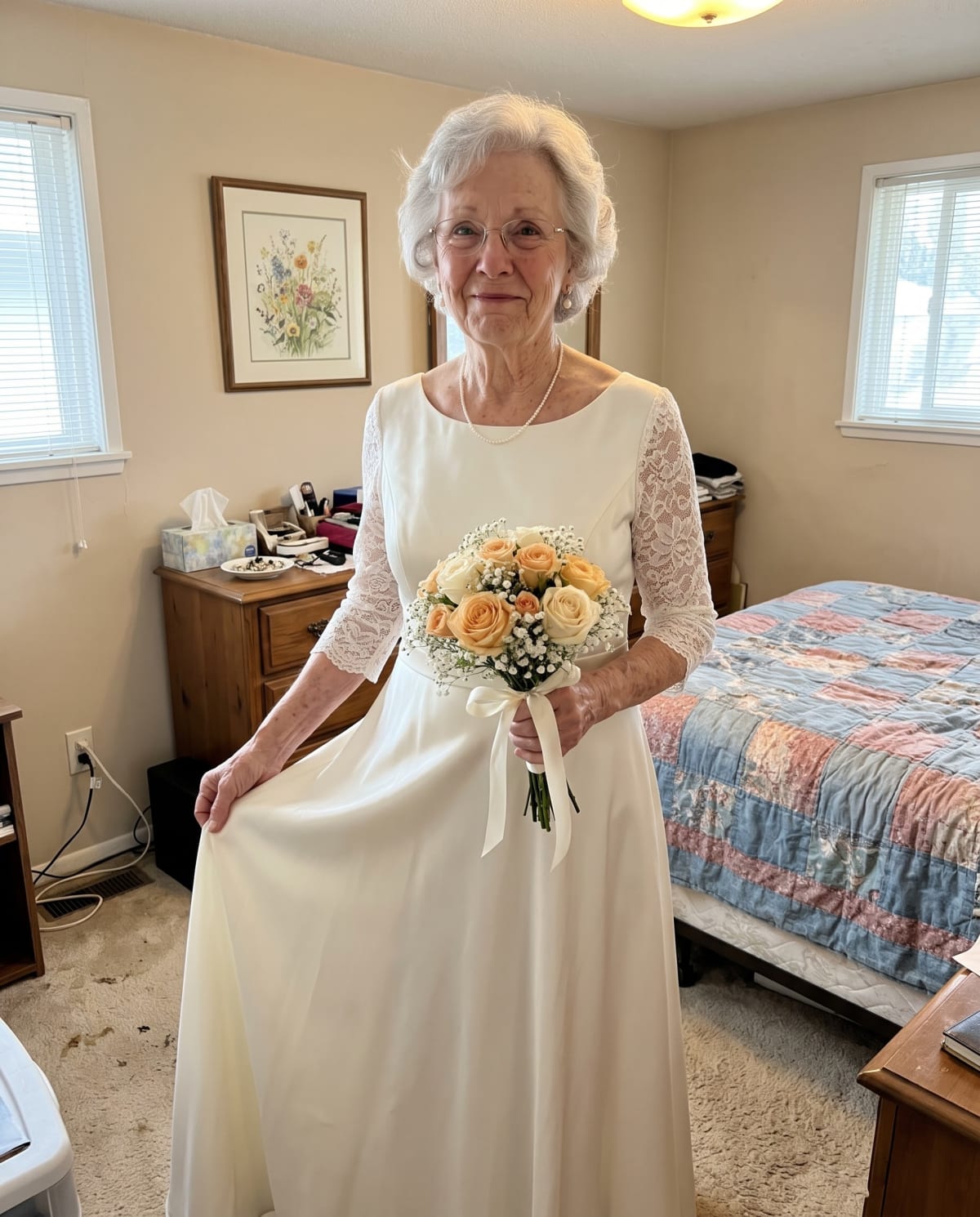
Garrett had kissed me behind the bleachers in 1972 and promised, "Eleanor, someday I'll buy you a diamond ring."
Then life pulled us apart.
I married a good man. Garrett married a good woman. We both buried our spouses, raised our families, and somehow grew old without ever crossing paths again.
Fifty-three years passed that way.
Then he found me at a church bake sale.
I was arranging lemon bars on a card table when I heard a voice I thought I'd never hear again.
"You still wear your hair the same."
I turned around and there he was—older, grayer, but unmistakably Garrett.
My hands shook so badly I dropped a lemon bar right onto the tablecloth.
"And you still talk too smoothly," I told him, trying to smile like my heart wasn't doing backflips.
He laughed—that same laugh that had made me feel like the only girl in the world when I was seventeen.
We talked for forty-five minutes at that bake sale while the other ladies pretended not to stare.
He told me his wife had passed five years ago. I told him my husband had been gone for three.
"I never stopped thinking about you," Garrett said quietly.
"That's not true," I said, but I was lying to myself and we both knew it.
He asked for my phone number before he left.
I gave it to him.
Garrett called that evening.
We talked until midnight.
Then we talked the next day, and the day after that.
Within three weeks, he was driving out to my little duplex with homemade soup his housekeeper had prepared.
Within two months, he was spending every evening on my worn couch, holding my hand like he was afraid I might disappear again.
"Eleanor," he said one evening in January, "I know this is fast. I know people will talk. But I've already lost you once in this life, and I'm not going to waste another day."
He got down on one knee.
"Will you marry me?"
I said yes before he even finished the question.
Not for the mansion I'd never asked to see. Not for money I didn't need.
But for the boy who had once walked me two miles home in the rain and never once complained about his wet shoes.
His children never believed that.
Garrett's daughter made that clear the day after the wedding announcement.
She showed up at my duplex unannounced, her face tight with anger.
"My mother hasn't been dead five years," she said coldly.
"I know," I whispered. "I'm so sorry for your loss."
"Don't you dare," she snapped. "Don't you dare speak about my mother. You're a vulture, and my father is clearly in some kind of dementia."
I tried to explain that we had known each other decades ago, that this wasn't some sudden infatuation, but she wouldn't listen.
She left my house and called her brother.
They hired a private investigator to look into me, as if I were some kind of con artist.
The investigator found nothing, because there was nothing to find.
But his children didn't care about facts.
They cared about their inheritance.
Still, Garrett and I got married.
It was a small ceremony at the courthouse, just my sister and her husband as witnesses.
Garrett slipped a diamond ring on my finger—the same diamond he'd promised me fifty-three years before.
I cried so hard I could barely see my own hand.
"I told you I'd give you this someday," he said, kissing my tears away.
"I never doubted you," I whispered.
We only had four months of marriage.
Four perfect, wonderful months where we felt like teenagers again, sneaking around like his children wouldn't approve—which they didn't.
We took a trip to the Grand Canyon. We danced in our kitchen. We held hands at every restaurant we went to.
"I love you," he said one night as we lay in bed. "I've loved you since 1972."
"I love you too," I told him. "Even when I was trying not to."
Then one morning in May, I woke up and Garrett wasn't breathing.
The heart attack came without warning.
One second he was sleeping peacefully next to me, and the next second my entire world was gone.
I called 911, but I already knew it was too late.
His children arrived at the hospital before the sun came up.
His daughter looked at me with pure contempt.
"Get out," she said flatly. "You've embarrassed our mother's memory long enough."
His son stepped closer, his jaw clenched.
"You need to leave before we have you physically removed."
I tried to explain that I was Garrett's wife, that I had every right to be there, but security was already approaching.
"Please," I begged. "Just let me see him one more time."
They didn't answer. They just turned their backs.
His son dropped my old suitcase at my feet the next day.
I had packed a small bag when I married Garrett, planning to collect my things properly from my duplex once we settled into married life.
But we never got that chance.
He'd wanted me to move into his mansion, to have my things brought over gradually.
Now his children were making sure I left with nothing.
"Please," I whispered. "At least let me take his photograph. The one from our wedding."
"No," his daughter said coldly. "Nothing in this house belongs to you. You were married for four months. You don't deserve anything."
So I left in the same dress I had worn to bury my husband.
The blue dress I'd carefully pressed and worn to the funeral service, where Garrett's children made sure I sat in the back.
I moved into my sister's old trailer by the county road.
She had passed it down to me years before, and I'd kept it as a guest house, but now it would be my home again.
I sat in that small living room for days without speaking.
I missed Garrett more than I could put into words.
More than I could even understand.
My sister kept bringing me casseroles that I couldn't eat.
"Give it time," she kept saying. "Time heals all wounds."
But I didn't want time to heal this wound. I wanted to feel it forever, because feeling the pain meant Garrett was still real to me.
Two weeks after the funeral, I was hanging laundry on the line outside my trailer.
The sheets were still damp from the morning rain, and my hands were numb from the cold.
I heard tires crunching over the gravel before I turned around.
A black limousine was pulling up outside my trailer.
My heart stopped.
For one impossible second, I thought maybe it was all a mistake, that Garrett was coming back to get me.
But of course he wasn't.
An attorney stepped out in a gray suit, holding a briefcase in one hand and a sealed envelope in the other.
He looked uncomfortable, like he'd never delivered news to a trailer house before.
"Eleanor?" he asked softly.
I nodded, still holding wet sheets in my arms.
"I'm David Chen, Garrett's attorney," he said. "I'm sorry for your loss. He was a good man."
"Thank you," I whispered.
"Eleanor, I'm here because Garrett left very specific instructions regarding you," he continued. "He wanted to make sure that you were taken care of. He wanted to make sure you got exactly what you deserved."
My hands were trembling so badly that the wet sheets nearly fell to the ground.
I looked at the sealed envelope with my name written in Garrett's familiar handwriting.
"What is this?" I asked.
"Garrett came to see me six months ago," Mr. Chen explained. "He told me he was going to marry you, and he wanted to make provisions. He said the marriage might be contested, and he wanted to protect you."
I couldn't speak.
"He left me very clear instructions," Mr. Chen continued. "I was only to deliver this envelope in person, directly to you, if something happened to him. He also left me with documentation. His children cannot challenge what's inside this envelope."
He handed me the sealed envelope.
My hands were shaking so badly that it took me three tries to break the seal.
Inside was a letter in Garrett's handwriting.
My dearest Eleanor,
I know this letter is probably a surprise. I hope you never have to read it.
But if you are reading it, then I've gone, and I want you to know that even in death, I made sure you would be all right.
I never could give you much when we were young. I was too poor, too uncertain, too afraid of the future.
But I can give you something now.
I'm leaving you the house I bought with my wife. Not because I've forgotten her—I never will. But because that house was filled with memories, not love. And when I found you again, I realized that real love is what fills a home, not just time.
My children will be angry. They may contest my will. They may say terrible things about you.
But I've made sure my attorney has the paperwork to protect you. I've made sure they cannot touch what I'm giving you.
Eleanor, you deserve to live in that house without fear or worry. You deserve to walk through those rooms and not feel like an intruder. You deserve to be happy.
I've also set aside money for you. Enough to ensure you never have to worry about anything again.
Not because you married me for it. You didn't. You married me because we found each other again, and we were both foolish enough to believe in second chances.
I love you.
I've always loved you.
And even though I won't be there to see you wear that diamond ring in happiness, at least I can make sure you're safe.
All my love, Garrett
I sank down right there in the dirt, the letter still in my trembling hands.
Mr. Chen waited quietly while I cried.
"There's more," he said gently after a few minutes.
He opened his briefcase and showed me the paperwork.
The house was mine. The accounts were in my name. The will was ironclad and notarized, protected in ways that Garrett's children could never touch.
His children had received their inheritance—substantial amounts of money and properties.
But Garrett had ensured that I, his legal wife of four months, received the one thing that mattered: security. Independence. A home.
"He was very thorough," Mr. Chen told me. "He anticipated that his children might contest things. He left detailed documentation explaining his state of mind and his intentions. He visited a psychiatrist specifically so there would be medical records proving he was in his right mind when he made these decisions."
"He really thought of everything," I said, reading through the pages.
"He really did," Mr. Chen agreed. "He said to me, 'I lost Eleanor once because I wasn't strong enough to fight for her. I'm not going to lose her again, even after I'm gone.'"
I couldn't stop crying.
Garrett's daughter called me three days later.
Her lawyer had informed her of her father's will, and she was furious.
"How did you do this?" she demanded. "How did you manipulate him into changing everything?"
"I didn't," I said quietly. "Your father did this on his own."
"He was sick," she hissed. "You took advantage of a lonely old man."
"Your father was the clearest-thinking person I've ever known," I replied. "And I think deep down, you know that."
She hung up on me.
His son tried a different approach.
He showed up at the mansion two weeks later with a mediation specialist, trying to convince me to sign away my inheritance in exchange for a smaller settlement and his family's acceptance.
"She just wants this to go away," his son explained. "We can make this easy for you."
"Your father wanted me to have this," I said simply.
"My father was confused," his son argued.
"Then why did he visit a psychiatrist?" I asked. "Why did he hire Mr. Chen? Why did he make sure every possible legal base was covered?"
His son had no answer.
I refused the settlement.
They sued anyway, but Mr. Chen had been right. The will was airtight.
After six months of legal battles that they lost, Garrett's children gave up.
I moved into the mansion on a cold gray day in November.
It was the hardest and the most healing thing I could have done.
Every room held memories of Garrett and me—our wedding planning on that same mahogany table, our dancing in that kitchen, our sitting on that porch swing holding hands while we talked about the life we wished we'd had together.
But now it was mine.
Not to prove anything to his children.
Not to show them up or make them jealous.
But because Garrett had given it to me, and in a strange way, it felt like his love continuing long after his heart had stopped.
I planted a garden in the backyard.
I renovated the guest house into a study where I could sit and read.
I donated money to the church where Garrett and I had found each other again.
And sometimes, on quiet evenings, I sat in that porch swing and felt like Garrett was still there, still keeping his promises to me.
Still loving me the way he said he would when we were seventeen years old and the world felt full of possibility.
Some people get one love story in their lives.
I was blessed to get two.