My mother, Frances, was always a quiet, gentle woman who enjoyed the little things in life.
After Dad passed away, she struggled with living alone. So I started visiting every weekend, bringing groceries, helping around the house, and keeping her company.
It became our little tradition.
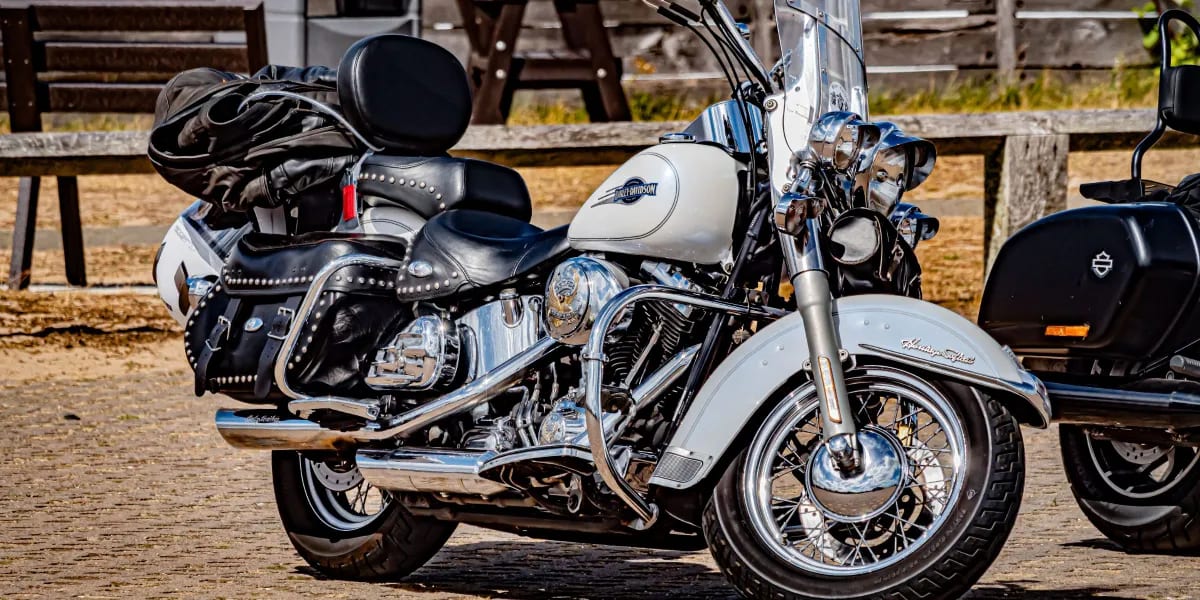
Then one Saturday, I pulled into her driveway and noticed a huge motorcycle parked outside.
Standing beside it was an enormous bearded man in a leather jacket.
Before I could even ask who he was, Mom came outside smiling.
"Oh, hi, sweetie! I won't have much time today."
"Mom, who's that?"
"This is Connor. He's taking me for a drive."
I stared at her.
"A drive? On that motorcycle?"
She laughed.
"Don't look so shocked, honey!"
I honestly thought she was joking.
But she wasn't.
After that, Connor showed up almost every weekend, and Mom would disappear with him for hours.
Naturally, I was worried.
"Mom, you barely know this man!"
"He's a good person, sweetheart."
"But what if something happens?"
"Connor is careful. And I want to go."
Then she said something I'll never forget.
"It's the one thing that makes me feel truly alive again."
I didn't know what to say.
Connor was always polite when he picked her up, always respectful. He'd greet me with a nod and a "ma'am," and he never tried to rush her.
Mom seemed happier than she'd been since Dad died. So eventually, I stopped questioning their little weekend trips.
For months, everything seemed fine.
Then Mom was diagnosed with a serious heart condition.
Her health declined much faster than anyone expected.
And just a few months later, she was gone.
Losing her after already losing Dad absolutely broke my heart.
At her funeral, I noticed Connor standing quietly near the back.
He looked devastated, like he'd lost someone he loved.
After the service, he approached me.
"I'm so sorry for your loss," he said softly.
"Thank you. Mom really enjoyed spending time with you."
He nodded, his eyes filling with tears.
"Your mom was an amazing woman."
Then his expression suddenly became serious.
He glanced around, stepped closer, and lowered his voice.
"But you need to know where we really went."
My stomach dropped.
"What do you mean?"
He took a deep breath.
"Can we talk somewhere private?"
We found a quiet corner of the funeral home, away from the other guests.
Connor sat down heavily, like the weight of whatever he was about to tell me was physically crushing him.
"Every time I picked up your mom, we didn't just go for drives," he said quietly.
"Then what did you do?"
He looked me in the eyes.
"We went to St. Vincent's Children's Hospital."
I froze.
"The hospital?"
"Your mom had been volunteering there for the past year. She spent those afternoons reading to the kids, sitting with the ones who didn't have visitors, holding their hands."
I felt tears start streaming down my face.
"She never told me."
"She didn't want you to worry about her being around sick children," Connor said. "But she felt like it was important. She said those kids needed her."
"How did you two meet?"
Connor rubbed his eyes.
"I volunteer there too. I mentor troubled youth, and I help out in the pediatric ward on weekends. That's where I met your mom."
I couldn't believe what I was hearing.
"She was at the hospital every single time?"
"Every single time," Connor confirmed. "And she was incredible with those kids. They loved her. Some of them called her 'Grandma Frances.'"
I thought back to all those afternoons I'd imagined my mother on some thrilling motorcycle adventure, and instead she'd been doing something far more meaningful.
"Why didn't she tell me?"
Connor leaned back in his chair.
"She said you were already grieving your father, and she didn't want you to feel responsible for her happiness. She wanted you to know that she was moving forward, that she was living her own life. But she didn't want you to feel guilty for not being there with her."
That sounded exactly like my mother.
"There's something else," Connor said.
"What?"
He reached into his jacket pocket and pulled out a folded envelope.
"Your mom gave me this about a month ago. She said to give it to you after she passed. She said she was running out of time, and she wanted you to understand everything."
My hands were shaking as I took the envelope.
"Did you read it?"
"No. It's not my place. But she told me what it says, so I know she explained everything in there. The hospital, the kids, all of it."
I opened the envelope carefully.
Inside was a letter in my mother's handwriting, along with printed photos of her at the hospital with sick children, playing board games with them, laughing with them.
The letter started: "My dearest, I know you're probably confused right now. Let me explain why I've been living a double life..."
She wrote about how after Dad died, she felt like her life had lost its purpose. She described the emptiness of those long days alone in the house.
Then she wrote about the day she first arrived at St. Vincent's.
She'd volunteered for a simple reason: she wanted to help people who were suffering, just like she was suffering.
But what happened changed everything.
She met a seven-year-old girl named Sophie who had leukemia and no family visitors.
Mom spent that first afternoon braiding Sophie's hair and listening to her talk about her dreams.
Sophie told her that she was scared she'd be forgotten if she died.
My mother promised her she would never be forgotten, as long as she was alive to remember her.
After that day, Mom went back every week.
She met more children. She heard their stories. She became their grandmother, their friend, their person.
She wrote in the letter: "These children taught me how to live again. They reminded me that there is still beauty in this world, still love to give, still joy to find."
She explained why she hadn't told me: she worried I'd see it as her abandoning our tradition, or that I'd feel obligated to join her, or that I'd fret about her wellbeing.
She wanted me to have my own life, without the weight of her grief on my shoulders.
She wrote about Connor too.
She said he was a good man with a kind heart, and that he'd been a true friend to her.
The letter ended with: "Live your life for yourself, not for me. And if you get the chance, go to St. Vincent's Children's Hospital and tell those kids that Grandma Frances loves them, and that she always will."
I looked up at Connor with tears streaming down my face.
"Did you know the kids would need to hear from me?"
"Your mom made me promise I'd tell you everything. She wanted them to know that she loved them, that she hadn't abandoned them. She was worried they'd think she just disappeared."
"I want to go there," I said immediately.
"I'll take you," Connor said. "Whenever you're ready."
We went to St. Vincent's the following Saturday.
Connor and I walked into the pediatric ward, and I felt my heart break and heal all at the same time.
The staff knew exactly who I was.
One of the nurses hugged me.
"We've been so worried about these kids. They miss your mom so much."
We visited with the children who were there that day.
Some of them were too young to fully understand that my mother had passed away, but they knew she wasn't coming back.
Others were old enough to understand loss.
A boy named Marcus, who was about ten years old, was the first to ask.
"Is Grandma Frances coming back?"
"No, sweetheart," I said gently. "But she asked me to tell you something. She wanted you to know that she loved you very much. And that you'll always be in her heart."
He cried.
I held him while he cried.
There was a girl named Emma, who was bald from chemotherapy.
She showed me a drawing she'd made.
It was a picture of her and my mother sitting together on a motorcycle, flying through the sky with wings.
"Your mom said we could go anywhere together on her magical motorcycle," Emma explained softly. "Even to places medicine can't reach."
I understood then what my mother had really been doing.
She wasn't just reading to these children and sitting with them.
She was giving them hope.
She was showing them that life could still contain joy and adventure and magic, even when you were sick and scared.
Over the next few months, Connor and I became close friends.
We began visiting the hospital together on weekends, continuing my mother's work.
Connor introduced me to the other volunteers, the doctors, the families whose children were being treated there.
I learned that my mother had made quite an impact in just one year.
She'd inspired other volunteers to come and spend time with the kids.
She'd donated money to the hospital's arts program so the children could express themselves through painting and music.
She'd started a weekly reading circle that was now led by other volunteers, but her spirit was still there in every session.
One day, Emma asked me if I'd ever ride on Connor's motorcycle like my mom did.
"Would you want me to?" I asked.
"Yes," she said. "Because then you'd really understand why Grandma Frances loved it so much."
So one Saturday, I did it.
I climbed onto the back of Connor's motorcycle, and we rode through the city.
The wind in my hair, the rumble of the engine beneath me, the city passing by in a blur of colors and sounds.
And I understood.
For those few hours, I wasn't grieving.
I wasn't stuck in a hospital thinking about sickness and death.
I was alive.
I was present.
I was free.
That's what my mother had been doing.
She'd been living fully, and she'd been showing those children that it was possible to do the same, no matter what their circumstances were.
I realized that my mother had given me a gift far greater than I could have imagined.
She'd shown me that there is life after loss.
That there is meaning to be found in serving others.
That sometimes the most important things we do in our lives are the ones nobody else knows about.
Connor still visits me sometimes.
We ride to the hospital together on the weekends, and we spend our afternoons with the children.
The job has changed my life in ways I never expected.
I think about my mother every single day.
And I think about how grateful I am that Connor came and told me the truth.
Because if he hadn't, I would have never known the most important thing about my mother: that in her last year on this earth, she was living her most authentic, beautiful, meaningful life.
And now, in her memory, I get to live mine the same way.