For eighteen years, I told myself that silence was a form of love. My husband never agreed — and on our daughter's eighteenth birthday, he finally proved it. Our daughter had a twin. Her sister lived only nine days.
For eighteen years, our daughter believed she had come into the world alone.
Her sister — I'll call her Wren — was born eleven minutes later. Smaller, quieter, with a faint dimple near her left eye that appeared only when she cried. Our daughter, Maddie, was the loud one from the start. I used to say she'd done enough crying for two babies.
Then Wren was gone. The doctors called it SIDS — sudden, unexplained, no one's fault. But "no one's fault" doesn't comfort a grieving parent the way people expect it to. Anger has somewhere to go. Helplessness doesn't.
I remember taking apart the empty crib myself, piece by piece, before my husband Paul even got home from the funeral home. He stood in the doorway when he saw what I'd done and said nothing. We were both twenty-seven, and neither of us knew how to grieve — not alone, and certainly not together.
Maddie needed constant care those first months, and I'd sit up nights holding her, terrified and grateful in the same breath, then hating myself for feeling grateful at all.
Somewhere in that fog, Paul and I decided she didn't need to know. Not yet. Not as a baby, obviously — but the "not yet" kept stretching. Toddler years. Grade school. Middle school, when she went through a hard stretch with friends. High school, with its own storms. There was always a reason the timing felt wrong.
Paul disagreed, quietly and persistently. Every so often, usually while driving, he'd bring it up. "She deserves to know." And I'd find a reason it could wait a little longer. He never pushed past my refusal. I've wondered since whether that was kindness or exhaustion.
Our families adapted around the secret without ever discussing it outright. Photos disappeared from walls. Nobody said Wren's name at holidays. It became a kind of unspoken agreement that protecting Maddie meant erasing her sister.
Every year on Maddie's birthday, after the cake and the candles, Paul would disappear into the garage for an hour or more. I never asked why. I had my own quiet ritual — doing laundry that didn't need doing, folding towels until my hands stopped shaking. We each carried Wren alone, in our own way, in the same house.
On Maddie's eighteenth birthday, we had family and friends over — a cookout, a sheet cake, a used car in the driveway that made her shriek with joy. Watching her that happy should have been reason enough to keep quiet a while longer. Instead, Paul stood up after the presents and asked everyone for a moment alone with her.
I knew immediately what he meant to do. "Not now," I said. He looked at me — not angry, just certain. "Today's the day."
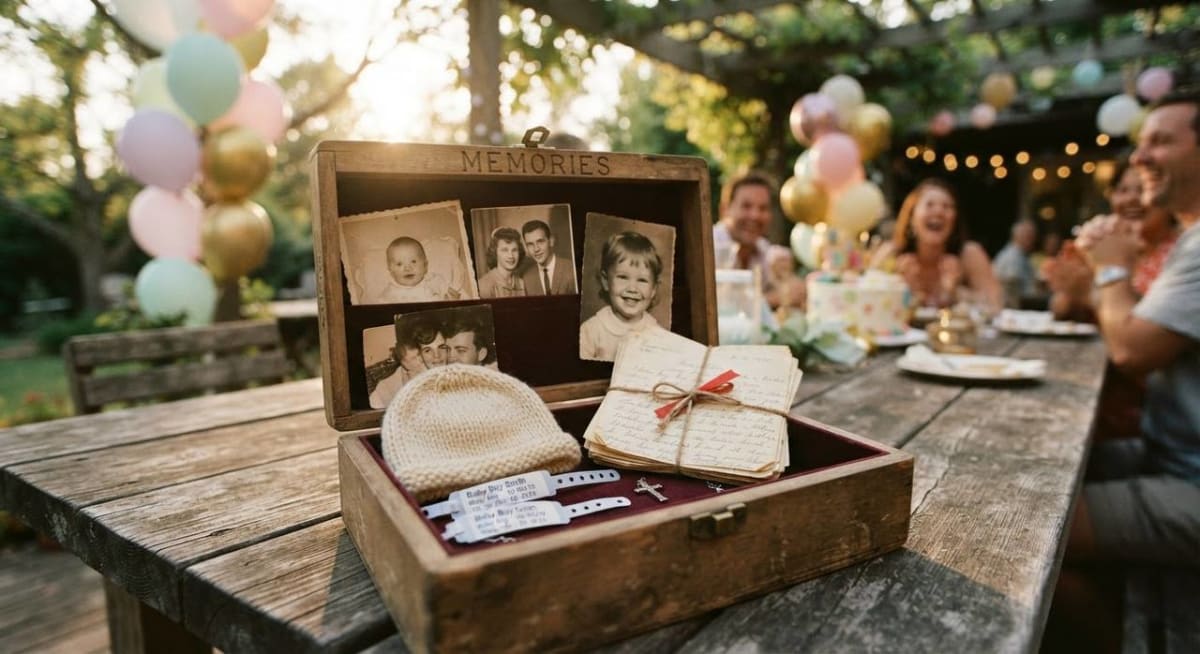
He walked into the garage and came back with a wooden chest I had never once seen in almost eighteen years living in that house. Handmade, a little uneven at the corners, clearly built by hand and not bought.
He set it in front of her and said the words I'd spent two decades avoiding: "You weren't born alone. You had a twin sister. Her name was Wren."
Maddie didn't cry. She didn't raise her voice. She just looked at the box, then at him, then at everyone who suddenly wouldn't meet her eyes. "Everyone knew?" she asked. "All of you kept this from me?"
Inside the chest, carved into the lid, were both their names side by side. Hospital bracelets. Two tiny hats. A stack of birthday cards and letters tied with ribbon — one written every single year, addressed to Maddie, about the sister she never knew she had.
She stood up before I could find any words that might have helped. "This is insane," she said, and walked away from the table — and, in that moment, from both of us.