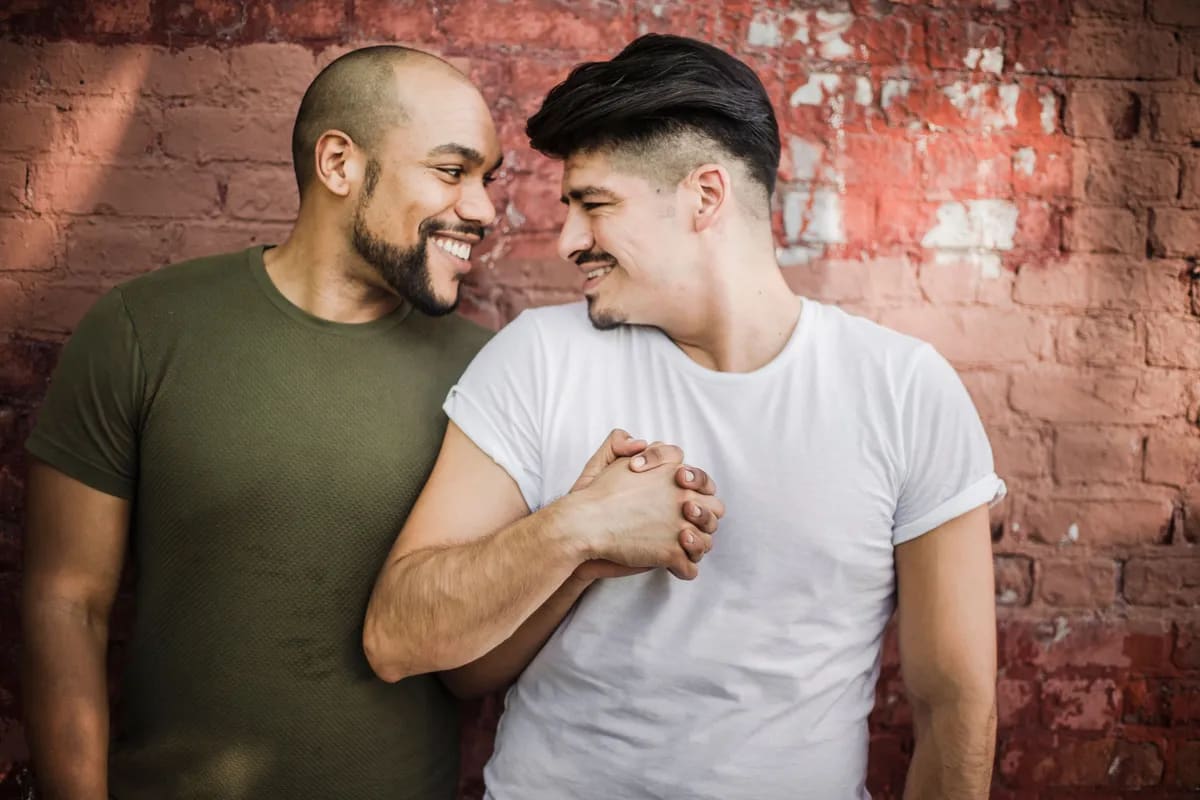
By the time my husband and I decided to adopt, we'd already lost people we loved simply because we loved each other.
My father stopped inviting me to Thanksgiving. Reid's mother still introduced me as his "friend," even with our wedding rings in plain sight.
Still, we wanted a family. And when we met Willa, we wanted her to be part of ours.
She was four, blind since birth, and had already moved between several foster homes. During our first visit, she sat beside me with a stuffed rabbit in her lap, rubbing its worn ear between her fingers.
When I stood to get a glass of water, she reached for my sleeve.
"Are you leaving?"
I told her I was only going to the sink.
She kept hold of my sleeve until I sat down again.
We knew she would need time to trust us. What we hadn't expected was how cruel people would be about our decision to love her.
"That child already can't see," my sister said. "Now you want her explaining why she has two dads? Hasn't she been through enough?"
Someone Reid had considered a friend told him, "If you really care about her, let her have a normal family."
Her caseworker told us ten prospective families had already passed after learning she was blind.
I remember Reid sitting at our kitchen table after that call, staring at the little yellow cup we'd bought for her.
"Do they think we haven't thought about what she needs?"
When Willa came home, she didn't ask about toys or the bedroom we'd spent weeks getting ready. She wanted to know where we would be sleeping and whether she was allowed to wake us.
For a while, she apologized whenever she needed help.
Reid learned to braid her hair. When she discovered baking, I labeled our kitchen jars in Braille and learned to stop reaching for things she could find herself.
By sixteen, she was stealing Reid's hoodies, negotiating her curfew, and telling me to get out of her kitchen.
"Dad, I can measure flour without supervision."
I loved hearing her say things like that. She no longer sounded afraid of taking up space in her own home.
Then, on the day of her sixteenth birthday, a man knocked on our door.
I recognized his face immediately. Reid and I had watched his latest movie the weekend before.
Then I realized he was Willa's spitting image.
But I'd never seen him in any of the photographs in Willa's file.
He gave his name, explained he was Willa's biological dad, and asked to come inside.
Willa was upstairs talking to a friend. In the kitchen, he barely touched the coffee Reid offered him.
"I know I've missed a lot," he began. "I'd like to do something for her now."
He mentioned college tuition, then a bigger house. I was still trying to understand why he'd come when he leaned forward.
"I want her to come stay with me. Tell me what it would take. I'll give anything."
Reid slowly set down his cup.
"You mean you'd like us to ask whether she wants to meet you?"
The man glanced toward the stairs.
"No. I literally need her to live with me. I need her with me next month."
"She doesn't even know you," I said.
He opened his bag and took out a folder.
"My team put together a proposal. Nothing would happen without your cooperation."
I opened it while Reid leaned closer.
There was a date for a television interview, a list of questions, and answers written beneath Willa's name.
In the first one, she described how her father had taught her to find her way around the kitchen.
I looked at the Braille labels on our jars.
"She doesn't remember you," I said.
He adjusted his watch.
"That's why we'd need some time together beforehand."
Reid turned another page.
According to this one, we'd been family friends who occasionally helped out.
"You told people you raised her?"
"In an interview. I mentioned having a daughter, and the conversation went further than I intended."
"So correct it."
He glanced at the folder.
"It's gotten a lot of attention. People want to meet her."
Upstairs, Willa laughed at something her friend had said. The man looked toward the ceiling, then back at us.
"I can pay for her education. Set her up for life. Surely we can find an arrangement that benefits everyone."
Reid stood and pushed the folder back across the table.
"I think you should leave."
But I was still looking at the last page.
There was one question his team hadn't written an answer for.
I read it twice, then closed the folder.
"An interview might be possible."
Reid turned toward me.
"What?"
I kept my eyes on our visitor.
"But there's one condition."
The man immediately reached for his pen.
"Name it."
I pulled the folder back before he could write anything.
"The answer to this question has to be true."
I pointed to the final line, the one without an answer beneath it.
The question read: "Tell us about your relationship with your adoptive fathers."
He stared at it for a long moment.
"I don't understand."
"That's the only interview she does. No coaching, no script. She tells the truth about who we are and what our family looks like. And millions of people hear it."
Reid sat back down beside me.
He saw what I was doing.
The man's jaw tightened.
"That wasn't the arrangement we discussed."
"There is no arrangement," I said. "That's my condition. Those are the only terms."
He stood abruptly, scraping his chair against our tile floor.
"You'd use her like that? Put her on national television to serve your own agenda?"
Reid leaned forward.
"We'd let her tell the truth about her family. The same thing you wanted her to lie about, except honest."
"She won't understand the implications."
"Yes, she will," I said. "She's intelligent and thoughtful, and she understands exactly who she is."
The man gathered his folder and moved toward the door.
"I could go to court."
"You could," Reid agreed. "But you won't."
He looked back at us.
"And why not?"
"Because you know what she'd tell them," Reid said. "And it wouldn't be what you want to hear."
The man stood in our doorway for another moment. Then he was gone.
We heard his car start in the driveway and listened to him drive away.
Reid reached over and squeezed my hand.
"That was gutsy."
Upstairs, Willa was still laughing.
I never told her that her biological father had visited. I wasn't sure what good it would do.
She would eventually find him on her own, I imagined. Maybe she'd want to know him someday. That would be her choice to make.
What I knew for certain was this: we weren't going to hide who we were or pretend to be something smaller than we were, just to make anyone else comfortable. Not for rejection from our families, not for judgment from neighbors, and not for a man who wanted his daughter to be a prop in his redemption story.
Willa was sixteen when he came to our house. By the time she graduated, she'd chosen a college scholarship, negotiated a better curfew, and started talking about studying environmental science.
She never asked about him. And I never brought it up.
Sometimes I wonder if he ever corrected that interview. If he ever told people the truth about where she was and who had actually been raising her all those years.
But mostly I think about that morning at our kitchen table, before he arrived. Willa had made us pancakes. Reid had eaten too many, and Willa had laughed at him.
That was our real life. That was the truth worth protecting.