Our mom passed away a week ago, and even though we knew her health had been getting worse, neither my brother nor I expected to lose her so soon.
She had been taken to the hospital toward the end, and we visited as often as we could. She was tired, but she was still herself. Still asking whether we had eaten. Still worrying about whether my brother was sleeping enough. Still telling me where she kept random things in her apartment as if she was going to be back there in a few days.
Then suddenly, she was gone.
For the first few days, neither of us could even think about going back to her apartment. But eventually, we had no choice. Someone had to figure out what to do with everything she had left behind, and just the thought of opening her closet or seeing her coffee cup sitting where she had left it made me feel sick.
So my brother and I agreed to go together.
When we got to her apartment complex, though, we stopped before we even reached the front door.
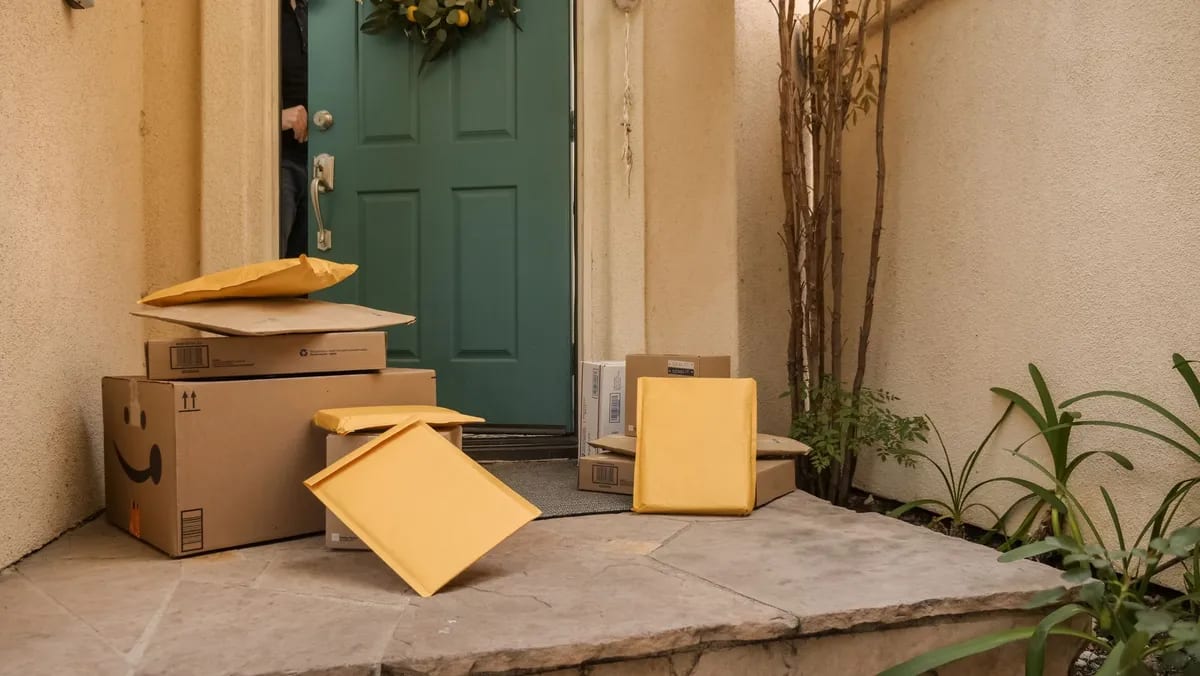
There were packages everywhere.
Not two or three. There had to be twenty, maybe thirty boxes piled around her door, along with shopping bags and smaller mailers shoved between them.
For a second, I honestly wondered whether Mom had secretly developed some kind of shopping problem.
But that made no sense.
My mother barely bought anything for herself. Most of her clothes were years old, and some of her sweaters she had knitted herself. The dishes in her kitchen were old vintage plates that had belonged to her grandmother. Half the furniture in her apartment had been there since I was a kid. I would have been surprised to find out she even knew how to use half of those online shopping apps.
My brother stared at the pile.
"Do you think these are from people who found out she died?" he asked. "Like sympathy packages or something?"
I shook my head and stepped closer.
"No. Look at the labels. These are from stores."
Different stores, too.
And almost every box had Mom's name on it.
My brother and I just stood there looking at each other.
Neither of us understood what we were seeing.
Finally, I pulled the apartment keys from my pocket and stepped carefully between the packages.
"I'm opening one."
I grabbed a medium-sized box near the door, tore through the tape, and pulled the top open.
The second I looked inside, my whole body went cold.
Then my eyes filled with tears.
"What?" my brother asked immediately.
I couldn't answer him.
He rushed over and leaned toward the box.
"What is it? What's inside?"
I sniffed and tried to get myself together, but I could barely speak.
"She knew," I whispered.
My brother looked at me.
"She knew what?"
"She knew she was dying. I think. I think she knew it was coming."
Inside the box was a brand new winter coat. My size. And it wasn't cheap—I recognized the label, a store I had mentioned liking months ago in passing.
My brother's face went pale.
We opened another box. Then another.
Inside them were things clearly meant for us. For me, specifically, and for my brother. Winter boots with a receipt dated from six months ago. A high-end coffee maker that I had once said my old one was breaking. A beautiful scarf in my favorite color. A leather wallet for my brother with his initials already embossed on it.
All of it in our sizes. All of it things we had casually mentioned wanting or needing at some point.
My brother sat down right there on the apartment stairs.
"She didn't tell us," he said.
"No," I agreed.
"She knew she was sick. I mean, we knew she was sick, but she must have known it was bad. Really bad."
I nodded.
Inside the apartment, we found notebooks. Not one or two. Dozens of them. Stacked on the dining room table, filling a shelf in her bedroom closet, tucked into drawers.
Each one was dated.
Each one was filled with notes.
Notes about us. Memories. Things we had done. Things we had said. Little jokes between us. Stories from our childhood. Recipes she wanted to make sure we had. Advice. Warnings about people to be careful of. Things she wanted us to know about our family history. Things she wanted us to know about herself.
It took us hours to go through everything.
By the time we finished reading, my brother and I were both crying so hard we could barely see.
"How long do you think she knew?" he asked me.
I shook my head.
"I don't know. But long enough to do all this."
He picked up one of the notebooks.
"Do you think she was scared?"
I thought about my mother's hands, how they had started to shake a little bit over the past year, even though she never complained. I thought about how she had started writing lists for us last spring, little things to remember, little things to do.
"Yeah," I said. "I think she was scared. But I think she was also trying to make sure we were going to be okay."
We brought everything into the apartment that day. All the packages. All the notebooks. All of it.
My brother and I sat there in her living room until very late that night, surrounded by the evidence of my mother's love.
"She really thought about us," my brother said finally.
"All the time," I answered.
The next morning, I found one more notebook we had somehow missed. It was smaller than the others, with a note on the cover in my mother's handwriting.
"For my two babies. Read when you're ready."
Inside was a letter.
It started: "My dearest ones. By the time you read this, I am gone. But I need you to know something. I need you to know that my life, all of it, every single day of it, became better the moment you were born."
It went on for fifteen pages. It was the most beautiful and heartbreaking thing I have ever read.
She had written about her fears. About how much she wished she could see us grow older. About how proud she was of the people we were becoming. About how sorry she was that she wouldn't be there for our weddings, or to meet our children, or to celebrate our successes.
But then she wrote: "What I want you both to understand is this: I am not sad about dying. I am sad about leaving you. There is a difference. A big difference. Because leaving you behind breaks my heart. But the life I got to live with you in it? That was a gift. That was the entire point."
She had also included practical things. Passwords to her accounts. Information about her insurance. Instructions for her funeral. She had thought of everything.
My brother and I read that letter together, out loud, taking turns with the paragraphs.
When we got to the end, my brother had to set it down because his hands were shaking too much to hold it.
"She really did know," he said.
"Yeah," I told him. "And she spent however much time she had left preparing to leave us as gently as she possibly could."
We spent the rest of that week going through the apartment. We kept the notebooks. We kept the gifts. We donated some things. We sold the furniture. But everything felt different now, knowing that she had been thinking about us the entire time, knowing that she had been trying, in her own way, to take care of us even as her body was failing.
The last thing we packed up was her bedroom.
My brother found something under her pillow: a picture of the two of us as children, maybe ages five and seven, both of us covered in mud from playing in the yard. On the back, in her handwriting, was a single sentence: "The two best things I ever did."
We decided to frame it.
It sits in my apartment now, right next to my bed. And every morning when I wake up, I see it.
And I remember that she knew. She knew the whole time. And she spent her last days making sure we would know, without a shadow of a doubt, exactly how much we were loved.
I miss her every single day. But I'm also grateful. Grateful for the foresight. Grateful for the love. Grateful that she had the strength to prepare us, even when she must have been terrified.
She left us the greatest gift of all: the certainty that we mattered to her more than anything else in the world.
And that's something I'll carry with me for the rest of my life.