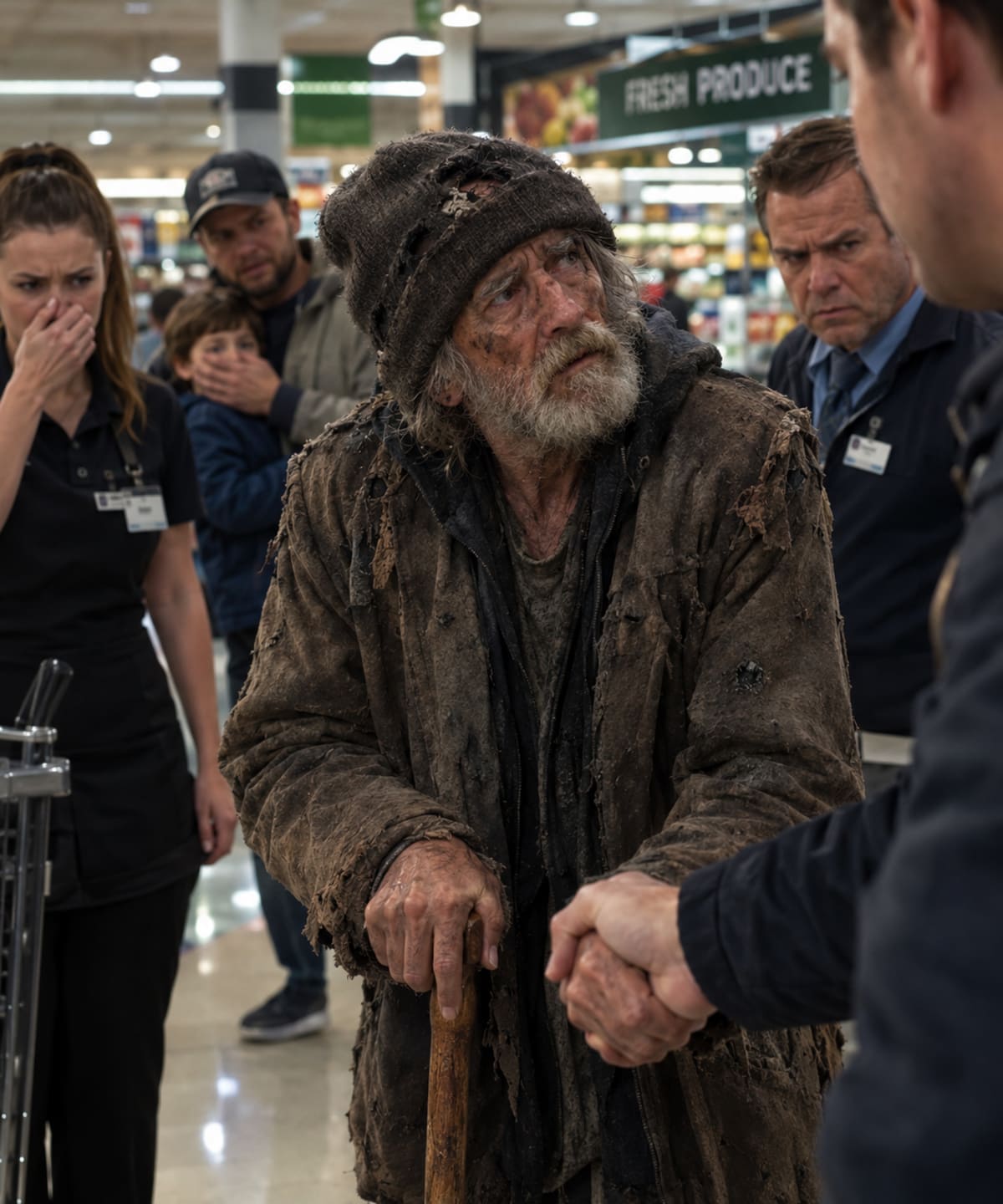
I'm Mr. Hutchins. I'm ninety years old. For nearly seventy of those years, I built the largest grocery chain in Texas.
It started with a drafty corner shop I opened after the war, with a borrowed cash register, three shelves of canned beans and a sign I painted myself. I worked eighteen-hour days. I slept on flour sacks in the back room. I knew every customer by name, and I knew which families couldn't pay until Friday.
That little shop became ten stores. Then fifty. Then hundreds, across five states. My name went up on trucks, billboards and warehouses the size of football fields.
I gained money, influence and thousands of employees. Senators called me by my first name. Magazines put my face on their covers.
Yet none of that warmed my nights.
The Question in the Empty House
My wife, Ellen, passed away in 1992. We never had children. It wasn't for lack of wanting. It just never happened for us, and after a while we stopped talking about it and poured everything into the stores instead.
After she died, the house became very quiet. Fifteen thousand square feet, and most nights I only used one chair in one room. The silence had a sound of its own.
One evening, sitting alone with a cup of tea I'd let go cold, I asked myself a single question:
Who deserves it all when I'm gone?
I had relatives, of course. Distant ones. A nephew who only called around the holidays and always seemed to mention a business opportunity. A grandniece who sent me birthday cards with her investment ideas tucked inside. Cousins I hadn't spoken to in decades who suddenly remembered how close we'd been.
I had seen what inheritance does to families. I had watched friends' funerals turn into battlegrounds. Smiles hiding knives. Relatives circling like vultures in pressed suits, arguing over paintings before the coffin was even closed.
I wanted none of that.
I didn't want my life's work handed to someone because of a shared last name. I wanted it to go to someone with a real heart. Someone who would understand what that corner shop had been about. Not money. People.
But how do you find a heart like that? You can't interview for it. Everyone is kind to a billionaire.
So I did something reckless.
The Disguise
I didn't tell my lawyer. I didn't tell my driver. I didn't tell anyone.
I shaved my hair unevenly with an old razor, leaving patches. I glued on a filthy, tangled beard I'd bought from a costume shop. I pulled on torn clothes I found at a thrift store and then rubbed them in the dirt of my own garden. I took an old wooden cane from the attic. I smeared dirt across my face and under my fingernails.
And, God forgive me, I even splashed myself with a carton of spoiled milk I'd left out on the porch for three days.
When I looked in the mirror, the billionaire was gone.
What stared back at me was an old, broken man. The kind of man people step around on the sidewalk. The kind of man nobody notices, and nobody helps.
I took a bus across town. The first in maybe forty years. The driver looked at me with disgust and pointed to the back. People moved seats when I sat down. A woman pulled her purse closer to her chest.
And I hadn't even arrived yet.
Walking Into My Own Store
I got off the bus and walked straight into my flagship store. The biggest one. The one with my name in letters six feet tall above the entrance.
The automatic doors opened for me. They were the only thing in that building that treated me the same as everyone else.
The air conditioning hit my face. The smell of fresh bread from the bakery, the hum of the freezers, the beep of scanners. I had walked these aisles a thousand times in a tailored suit, shaking hands, while managers rushed to greet me.
This time, nobody rushed.
The looks cut deep. People's eyes slid over me and then quickly away, the way you look away from a car accident. Shoppers turned their carts in the other direction.
At the checkout, a young cashier wrinkled her nose and whispered to her coworker, not quietly enough:
"He smells like garbage meat!"
Her coworker laughed.
I moved slowly toward the bread aisle, leaning on my cane. A man standing in line with his little boy pulled the child toward him and covered his nose with his hand.
"Don't stare at the tramp, Tommy," he said.
The boy kept looking at me anyway, with the honest curiosity that children have before the world teaches them who to ignore. I tried to smile at him. His father turned him around.
"Your Kind"
I picked up a loaf of bread. The cheapest one. I held it in my dirty hands and stood there, pretending to count coins I didn't have.
That's when the floor manager appeared.
I recognized him immediately. His name was Derek. Five years earlier, I had personally promoted him. I remembered the ceremony. I remembered him shaking my hand with both of his, telling me how much the company meant to him, how he believed in "the Hutchins family values." I remembered him saying that every customer deserved respect.
Now he stood in front of me with his arms crossed and his face twisted.
"Sir, you need to leave," he said loudly, so others would hear. "Customers are complaining. We don't want your kind here."
My kind.
I laid every tile beneath his feet. I had stood on a ladder myself at the opening of this store, hanging the first sign. The paycheck in his pocket carried my signature.
And I was "his kind" of problem.
I want to be honest with you: each insult didn't wound me as much as you might think. I had been poor once. I knew what it felt like. What each insult did was reveal the truth. The truth about the empire I had built, and who really controlled it when I wasn't watching.
I had built a company on the idea that everyone who walks through the door deserves dignity. And somewhere along the way, while I was in boardrooms and on magazine covers, that idea had quietly died.
I put the bread back on the shelf. My hands were shaking, and this time it wasn't part of the act.
I turned toward the exit. Defeated. Ready to go home and leave everything to a charity, to a foundation, to anyone at all, because clearly the people I had trusted with my name had forgotten what it meant.
That's when someone squeezed my hand. Very hard.
The Hand
It wasn't a gentle touch. It was firm, almost desperate, the way you grab someone who's about to step off a curb into traffic.
I turned to see who it was.
It was a young man, maybe twenty-three or twenty-four. He wore the green apron of a stock clerk, faded from too many washes. His name tag said LEWIS. He had a box cutter clipped to his belt and cardboard dust on his sleeves. His sneakers were taped at the side.
He was looking directly at me. Not past me. Not through me. At me.
"Sir," he said quietly, "please don't go. Come with me for a second."
Derek stepped forward. "Lewis, what are you doing? Get back to the stockroom."
Lewis didn't let go of my hand.
"He's leaving," Derek snapped. "I told him to leave."
"I know," Lewis said. "I'm just walking him out. Through the back. So he doesn't have to walk past everyone again."
Derek glared at him, then waved his hand in disgust. "Fine. Get him out. And you're on thin ice."
The Break Room
Lewis didn't walk me out the back door. He walked me into the employee break room.
It was a small, windowless room with a buzzing light, a scratched table, a microwave, and a bulletin board covered in safety notices. On the wall hung a framed photo I hadn't seen in years: me, much younger, standing in front of that first corner shop, holding a broom.
My heart stopped for a second. If he looked at that photo, then at me, he might recognize me.
But Lewis didn't look at the photo. He pulled out a chair for me and said, "Sit down, please."
Then he went to the fridge, took out a paper bag with his name written on it in marker, and set it in front of me. Inside was a sandwich wrapped in foil, an apple, and a small bag of chips.
"It's turkey," he said. "My sister makes them. She puts too much mustard, sorry."
"That's your lunch," I said. My voice came out rough and quiet, which made the disguise even more convincing.
"I'm not that hungry today," he said.
It was obviously a lie. He was thin, and I had heard his stomach growl as we walked.
He poured me a cup of water from the cooler and sat down across from me while I ate. He didn't ask questions at first. He just let me eat, as if it were the most normal thing in the world.
When I finished, he reached into his pocket and pulled out a crumpled twenty-dollar bill and a bus pass.
"There's a shelter on Fifth Street," he said. "They have beds tonight, I checked last week. The bus stops right outside. And this..." He pushed the twenty toward me. "Just get something warm for dinner."
"Son," I said, "you can't afford to give this to me."
He smiled a little. "Probably not. But I can't afford not to, either."
Why He Did It
I had to know. I had promised myself I wouldn't break character, but I had to ask.
"Why?" I said. "Everyone else out there looked at me like I was trash. Your manager threw me out. Why would you risk your job for an old bum who smells like spoiled milk?"
Lewis looked down at the table for a while.
"My grandpa raised me and my sister," he said finally. "After our parents were gone. He worked his whole life, construction, forty years. Then he got sick. Dementia. Sometimes he'd wander out of the house and we'd find him hours later somewhere across town."
He swallowed.
"One time he walked into a store like this one. He was confused, his clothes were dirty because he'd fallen down. And they threw him out. A security guard pushed him and he fell on the sidewalk and broke his wrist. Nobody helped him. Nobody even called anyone. A lady at a bus stop finally gave him her phone so he could call us. He couldn't even remember the number. She sat with him for two hours until he did."
Lewis looked up at me.
"He died two years ago. I never found out who that lady was. I never got to thank her. So I figure..." He shrugged. "Every person who walks in here looking lost, that could be somebody's grandpa. I can't thank her. But I can be her for somebody else."
I didn't say anything for a long time. I couldn't.
That night, I took his twenty-dollar bill and his bus pass. And I thanked him. He walked me to the back door, squeezed my shoulder, and said, "Take care of yourself, okay? And if you need lunch again, come in on Tuesdays. Derek's off on Tuesdays."
I laughed for the first time in months.
The Next Week
Two days later, Lewis was fired.
Derek had written him up for "allowing an unauthorized person into a restricted area" and "neglecting assigned duties." It was his third write-up. I later found out that the first two were for staying past his shift to help an elderly customer carry groceries to her car, and for giving a crying child a free cookie from the bakery.
I found all of this out because, the following Monday, I walked into that same store again.
This time, I had a tailored suit, a fresh haircut, a clean shave, and my driver opening the door of a black car parked right in front of the entrance. Beside me walked my lawyer and two members of the company's board.
The automatic doors opened exactly as they had before.
This time, everyone rushed.
The Return
Derek practically ran across the store, straightening his tie.
"Mr. Hutchins! What an honor, sir. We had no idea you were visiting. If we'd known, we would have prepared..."
"Prepared what?" I asked.
He blinked. "The store, sir. To make sure everything met your standards."
"I've already seen the store," I said. "Last Thursday. Around four in the afternoon."
His face went white. He looked at me, really looked, and I watched the understanding crawl across his features like a shadow.
"I believe," I said, "you told me that you don't want my kind here."
The cashier who had said I smelled like garbage meat dropped a roll of receipts. Nobody in the front of the store moved.
"Sir, I... I didn't know..."
"That's the point, Derek," I said quietly. "You didn't know. And because you didn't know, you showed me exactly who you are. The question was never whether you'd respect me. The question was whether you'd respect someone you thought didn't matter."
I didn't yell. I didn't need to. My lawyer handed him an envelope. Derek no longer worked for my company.
The cashier was sent to a full retraining program and was told her second chance depended on it. She cried, and to her credit, she apologized to me directly, without excuses. I accepted. People can change. I believe that. But only if someone shows them the cost of who they were.
Then I asked the assistant manager a single question:
"Where is Lewis?"
Finding Lewis
He lived in a small rented apartment on the east side of town, on the second floor of a building with a broken buzzer. I climbed the stairs myself, with my real cane this time.
His younger sister, a teenager with braces and the same serious eyes, opened the door. She looked at my suit, then at the black car parked downstairs, and called over her shoulder nervously, "Lewis? There's... a man here."
Lewis came to the door with a stack of job applications in his hand. He looked at me politely, a bit confused.
"Can I help you, sir?"
I reached into my coat pocket and pulled out a crumpled twenty-dollar bill and a bus pass. I held them out to him.
"I believe these are yours," I said.
He stared at the money. Then at my face. Then at my eyes.
I saw the exact moment he recognized me. His mouth opened. The job applications slipped from his hand and scattered across the floor.
"No way," he whispered. "No. Way."
"Turkey with too much mustard," I said. "Tell your sister it was the best sandwich I've had in years."
The Conversation
We sat at his tiny kitchen table for three hours.
I told him everything. About Ellen. About the empty house. About the relatives and their birthday cards. About the question I had asked myself, and the reckless plan I'd made to answer it.
He listened in complete silence. When I finished, he shook his head.
"Mr. Hutchins, I don't... I didn't do anything special. I gave a guy a sandwich."
"Son," I said, "I walked through a building full of hundreds of people, most of whom are paid with my money. Only one of them saw me. Only one of them held my hand. You think that's not special? That's the rarest thing in the world."
He was quiet for a while. Then he said something I'll never forget.
"If you're going to offer me money because of what I did, I don't want it. I didn't help you for a reward. If I take a reward, then it wasn't really... you know. It turns into something else."
And that was the moment I knew for certain.
The relatives would have taken the money before I finished the sentence. Lewis was the only person I'd met in thirty years who tried to refuse it.
The Offer
I didn't make him my heir that day. I wasn't a fool, and neither was he.
Instead, I offered him a job. Not a handout. Real work. He would start at the bottom of the corporate office and I would teach him everything I knew. How to read a balance sheet. How to negotiate with suppliers. How to run a store. How to look at a spreadsheet full of numbers and remember that every number is a person.
He also had one condition: his sister had to finish school, and he wanted to take night classes. I paid for both, and he insisted on paying me back, twenty dollars a week. I never cashed a single check. I kept them all in a drawer.
For three years, Lewis worked harder than anyone I had ever employed. He arrived first and left last. He visited stores without warning, and he always went to the break rooms before the offices. He learned the names of the stockers and the cashiers and the janitors. Employees started to call him, half joking, "the guy from the back room."
He started a program called Tuesday Lunches. Every store in the chain now keeps a quiet table and free meals for anyone who walks in hungry, no questions asked. Managers are trained to treat every person who walks through the door the same, whether they arrive in a black car or with a cane and torn clothes.
The program cost money. The board complained. And yet, somehow, customer loyalty went up. Employee turnover went down. People like to shop at a place that has a soul.
I should have known that. I had known it once, in a drafty corner shop seventy years ago.
The Will
I'm writing this now from the