I was a pediatric surgeon for almost forty years. In that time I held hundreds of small hearts in my hands, hearts no bigger than a plum, beating against my gloved fingers like frightened birds. People assume you get used to it. You don't. You just learn to keep your hands steady while everything inside you shakes.
Some patients you forget. Some you remember for a week, maybe a month. And then there are the ones who stay with you for the rest of your life.
Owen was one of those.
The Boy With the Enormous Eyes
He was six years old when I met him, though he looked closer to four. He was all bones: thin wrists, sharp shoulders, a chest that rose and fell too quickly. His skin had that faint bluish tint around the lips that every heart surgeon learns to recognize from across a room.
But what I remember most were his eyes. They were huge, dark and full of fear. They followed every person who walked into his room, watching hands, watching needles, watching faces for any sign of bad news.
His chart told the story his body was already telling. A congenital heart defect, complex and long neglected. The kind of condition that should have been treated years earlier. The kind that steals a childhood one missed breath at a time. While other kids his age were running across playgrounds, Owen was sitting on the sidelines, too tired to climb the stairs.
The surgery was risky. I won't pretend otherwise. I sat down with his parents the day before and explained everything as gently and honestly as I could: the risks, the chances, what recovery would look like.
His mother barely spoke. She was young, maybe twenty-five, with tired eyes and bitten fingernails. She kept nodding, but I wasn't sure she was hearing me. His father stared at the floor the entire time, his jaw tight, his knee bouncing.
I remember thinking they were simply terrified. Most parents are. I had no idea how much more was going on behind their silence.
The Surgery
The operation lasted almost seven hours.
There were moments when the room went completely quiet, when the only sounds were the machines and the soft instructions passing between my team and me. There was one moment, around the fourth hour, when I genuinely wasn't sure we would bring him back.
But Owen was a fighter. That tiny heart, once we repaired it, began to beat stronger and steadier than it ever had in his life.
When I walked out into the waiting room, his parents stood up so fast the mother knocked over her chair. I told them the surgery had been a success. That their son was going to live. That he would have a chance at a normal childhood.
His mother covered her mouth with both hands and started to cry. His father turned away and pressed his forehead against the wall.
I went home that night exhausted but happy. It was one of the good days. The kind of day that reminds you why you chose this impossible job.
The Empty Room
The next morning, I came in early. I wanted to see Owen myself. I expected the usual scene: an exhausted mother asleep in the chair, a father holding a paper cup of terrible hospital coffee, relief written all over their faces.
Instead, Owen was alone.
The chair beside his bed was empty. There was no bag, no jacket, no phone charger plugged into the wall. Just a small plastic dinosaur lying on the blanket next to his hand, and a half-empty cup of juice on the tray table that someone had forgotten.
He was awake, staring at the ceiling.
"Good morning, buddy," I said, sitting down on the edge of his bed. "How are you feeling?"
He shrugged with one shoulder, careful not to pull at his stitches.
"Where are your parents?" I asked gently.
He didn't look at me. He picked up the dinosaur and turned it over in his small fingers.
"They had to leave," he said.
Just like that. Flat, quiet, as if he had already accepted it. As if it wasn't the first time someone had left.
Something in my chest cracked open. I've heard many hard things in my career, but those four words from a six-year-old who had just survived open-heart surgery hit me harder than almost anything.
The Truth
I checked his vitals, told him I'd be back soon, and walked out into the hallway trying to keep my face calm.
The nurses already knew. The night before, after visiting hours, Owen's parents had gone to the front desk. They had signed every paper put in front of them, including documents they had clearly not read carefully. Then they walked out of the building and never came back.
The phone number in the file was disconnected. When social services checked the address, it turned out to be an empty lot.
Over the following days, pieces of the story came together. They had no insurance. They had no savings. They had been sleeping in their car for weeks before Owen was admitted. The father had lost his job. The medical bills, even the ones they had already received, were more money than they would earn in years.
They were broke. They were terrified. And they made the worst decision of their lives.
I want to be honest: in those first days, I was angry. How could anyone leave a child alone in a hospital bed, a child who had just been cut open and stitched back together? But beneath the anger, there was something else. Something closer to grief. Because I had seen that mother's face in the waiting room. That wasn't the face of someone who didn't love her son.
It was the face of someone drowning.
The Night Everything Changed
That night, I came home late. Later than usual. I sat in my car in the driveway for almost twenty minutes before I went inside.
My wife, Nora, was in the kitchen. She took one look at my face and didn't ask whether I was tired or whether I'd eaten. She just put down the dish towel and said, "Tell me."
So I told her. About the little boy with the enormous eyes and the fresh scar running down the middle of his chest. About the dinosaur toy. About the empty chair. About the words "They had to leave."
Nora listened without interrupting. When I finished, she was quiet for a long time.
You need to understand something about us. For eight years, Nora and I had tried to have a child. We tried everything doctors could offer. We went through hope and disappointment so many times that we eventually stopped talking about it. The empty room upstairs that we had once imagined as a nursery had slowly become a storage room, full of boxes we never opened.
Nora reached across the table and took my hand.
"If he has no one," she said softly, "then we can be his somebody."
I looked at her, and I knew she meant it with her whole heart.
Becoming a Family
It was not simple. Adoption never is. There were social workers, home inspections, court hearings, endless forms and long months of waiting. There was a period of temporary foster care, and nights when Nora sat by the phone afraid that someone would come and take him away.
The first weeks with Owen were hard in ways neither of us expected. He didn't cry when he was hurt. He didn't ask for anything. He hid crackers under his pillow. Whenever Nora left the house, even for ten minutes to buy milk, he would stand at the window until her car came back.
He was waiting for people to leave. Because that's what people did.
Nora never gave up. She read him the same dinosaur book every night until we both knew it by heart. She sat on the floor of his room until he fell asleep. She told him every single day, "I'm coming back. I always come back."
And slowly, so slowly that we barely noticed it happening, Owen began to believe her.
The first time he called her "Mom," she was making pancakes. He said it casually, without thinking: "Mom, can I have more syrup?" Nora froze with the spatula in her hand. Then she turned around, smiled, and said, "Of course, sweetheart." She managed to hold it together until he left the kitchen. Then she sat down on the floor and cried for ten minutes.
The first time he called me "Dad," I had to pretend I had something in my eye.
Growing Up
The scar on his chest faded over the years into a thin pale line. The fear in his eyes faded too, replaced by curiosity, mischief and a stubborn determination that reminded me of the way his little heart had refused to stop on the operating table.
Owen loved school. He was the kid who stayed after class to ask questions, the one who read the encyclopedia for fun. At ten, he announced that he was going to be a doctor. At twelve, he asked me to explain exactly what I had done during his surgery. I drew him a diagram on a napkin, and he kept that napkin in his desk drawer for years.
He never asked much about his birth parents. Once, when he was fourteen, he asked if they had ever tried to find him. I told him the truth: as far as we knew, they hadn't. He nodded, quiet for a moment, and then said, "Okay." And he went back to his homework.
But I saw something pass across his face. Something old. Something that had been waiting at a window for a long time.
My Son, My Colleague
Twenty-five years passed faster than I thought possible.
Owen graduated at the top of his class. Medical school, residency, long nights, exhausting shifts. He chose pediatrics. When I asked him why, he said, "Because somebody once fixed a scared little kid's heart. I want to be that somebody for someone else."
And then, one day, he walked through the doors of our hospital. The same hospital where he had once lain alone in a bed with a plastic dinosaur.
Only this time he was wearing a white coat with his name embroidered on it.
My son. My colleague.
The older nurses, some of whom remembered him as a child, cried openly on his first day. I tried to act professional. I failed completely.
Working beside him was one of the greatest gifts of my life. Watching him kneel down to talk to frightened children at eye level, watching him hold the hands of terrified parents, I sometimes saw that six-year-old boy again. Except now he was the one doing the comforting.
The Tuesday Everything Stopped
It happened on an ordinary Tuesday.
We were in the middle of a surgery together, a delicate valve repair on a nine-year-old girl, when my pager buzzed. Normally I would ignore it until we finished. But a nurse glanced at the screen and her face went pale.
She held it up for me to see.
PERSONAL EMERGENCY. NORA. ER. CAR CRASH.
My hands, which had been steady through thousands of operations, began to shake.
Owen saw it. He saw my face. Without a word, he signaled to the attending surgeon to take over, and the moment it was safe, we both pulled off our gloves and ran.
I don't remember the hallways. I don't remember the elevator. I only remember the sound of our footsteps and the pounding of my own heart, the same organ I had spent my entire life repairing in others, now beating so hard I thought it would break.
Alive
We burst into the emergency department and found her.
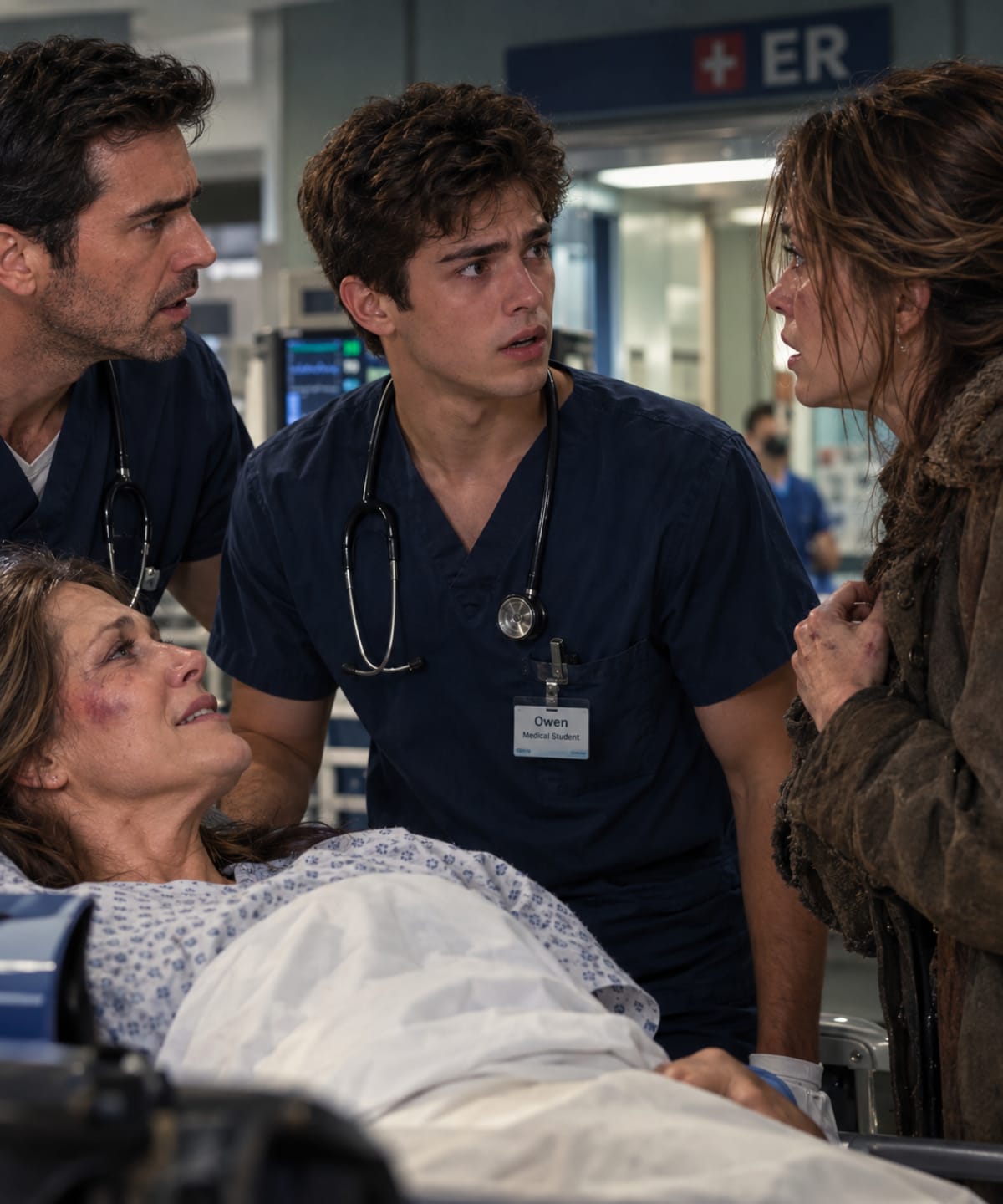
Nora was sitting on a stretcher, bruised along one side of her face, her arm wrapped in a temporary splint, her hands shaking. But she was alive. She was conscious. She was looking at us.
Owen reached her first. He grabbed her hand with both of his.
"Mom, are you okay?" His voice broke on the last word. In that moment he wasn't a doctor. He was a little boy standing at the window, waiting for her car to come back.
Nora smiled at him through the bruises. "I'm okay, sweetheart. I'm okay. I came back, didn't I?"
I had to hold onto the side of the stretcher to stay standing.
The Woman in the Worn Coat
Then Owen looked up, and I watched my son's face change completely.
Standing on the other side of Nora's stretcher was a woman I hadn't noticed. She was perhaps in her early fifties, though life had clearly aged her faster than that. She wore a thin, worn coat, frayed at the cuffs. Her hands were scraped and bleeding. There was a cut above her eyebrow. Her hair was gray at the roots.
A nurse quietly explained to me what had happened. Nora's car had been hit at an intersection and had flipped onto its side. Smoke was coming from the engine. This woman, a stranger walking by on her way to a night shift cleaning offices, had smashed the window with her bare hands and pulled Nora out before the paramedics arrived. Then she had refused to leave until she knew Nora was all right.
I wanted to thank her. I opened my mouth to speak.
But the woman wasn't looking at me. She wasn't even looking at Nora.
She was staring at Owen.
More precisely, she was staring at the open collar of his scrubs. In the rush, the top of his scrub shirt had pulled to the side, revealing the top of that thin pale scar running down the center of his chest.
Her lips began to tremble. Her scraped hand rose slowly to her mouth.
Then her eyes moved to his face. To his dark, deep-set eyes. The same eyes I had seen twenty-five years earlier in a hospital waiting room, looking at me with terror.
"Owen," she whispered.
The room went silent.
Owen's throat moved. He looked at her, confused, then down at his badge. It was flipped around backward on its lanyard. His name wasn't visible.
"How do you know my name?" he asked.
"I Was Your Mother"
The woman's knees nearly gave out. A nurse rushed to bring her a chair, but she didn't sit. She held onto the metal rail of Nora's stretcher as if it were the only solid thing in the world.
"Because I gave it to you," she said.
Nobody moved.
"I named you after my father," she continued, her voice barely above a whisper. "You were born in March, during a snowstorm. You had a heart murmur from the first day. The doctors told us we needed to get you surgery, but we didn't have insurance. We didn't have anything."
Owen's hand slowly let go of Nora's.
"We kept waiting," she said. "We kept thinking things would get better. That your father would find a job. That we'd save some money. But things only got worse. And you got sicker. By the time we brought you here, you could barely walk."
She looked at me then, and I saw recognition in her eyes.
"You were the surgeon," she said. "You told us you saved him."
I nodded. I couldn't speak.
The Night She Left
"That night," she said, tears running down her face now, "your father and I sat in the car in the parking lot. We had already received a bill for the tests alone. Thousands of dollars. We knew the surgery would cost more than we could ever pay. We had nowhere to bring you home to. We were living in that car."
She took a shaky breath.
"Your father said that if we left, the hospital would take care of you. That the state would find you a family with a real house and money and doctors. That staying with us would kill you, slowly, the way it almost already had."
She closed her eyes.
"I told myself it was love. I told myself I was giving you a chance. I signed the papers and I walked out of that building, and I have regretted it every single day of my life since."
Owen stood frozen. I had never seen him look like that, not even as a child.
"Your father left me a year later," she said quietly. "I came back to this city three times. Three times I stood across the street from this hospital, and I couldn't make myself walk in. I didn't think I had the right. I thought you'd hate me. I thought..."
She stopped. Her voice failed her completely.
"I thought you were better off never knowing me."
Silence
For a long moment, nobody said anything.
I looked at my son. A grown man, a respected doctor, a person who had saved dozens of children. And in his face I saw, all at once, the six-year-old boy sitting alone with his dinosaur. The kid hiding crackers under his pillow. The boy standing at the window.
Twenty-five years of questions he had never asked out loud were suddenly standing right in front of him, in a worn coat with bleeding hands.
"You left me," he said. Not loudly. Not angrily. Just a fact, the way he had once said "They had to leave."
"Yes," she said. "I did. And there's nothing I can say that will ever make that right."
Owen looked down at the floor. His jaw tightened, exactly the way his biological father's had in that waiting room long ago. I didn't know what he would do. I don't think he knew either.
What Nora Said
It was Nora who broke the silence.
She reached out with her good hand and touched the woman's scraped fingers.
"You pulled me out of that car," Nora said.
The woman nodded weakly.
"You didn't know who I was," Nora said. "You didn't know I was his mother. You just saw someone who needed help, and you broke a window with your bare hands."
Nora looked at Owen.
"Twenty-five years ago, she made a terrible decision because she was scared and desperate and had nothing. Today, she made a brave one. Both of those things are true, sweetheart."
Owen's eyes filled with tears.
"You don't have to forgive