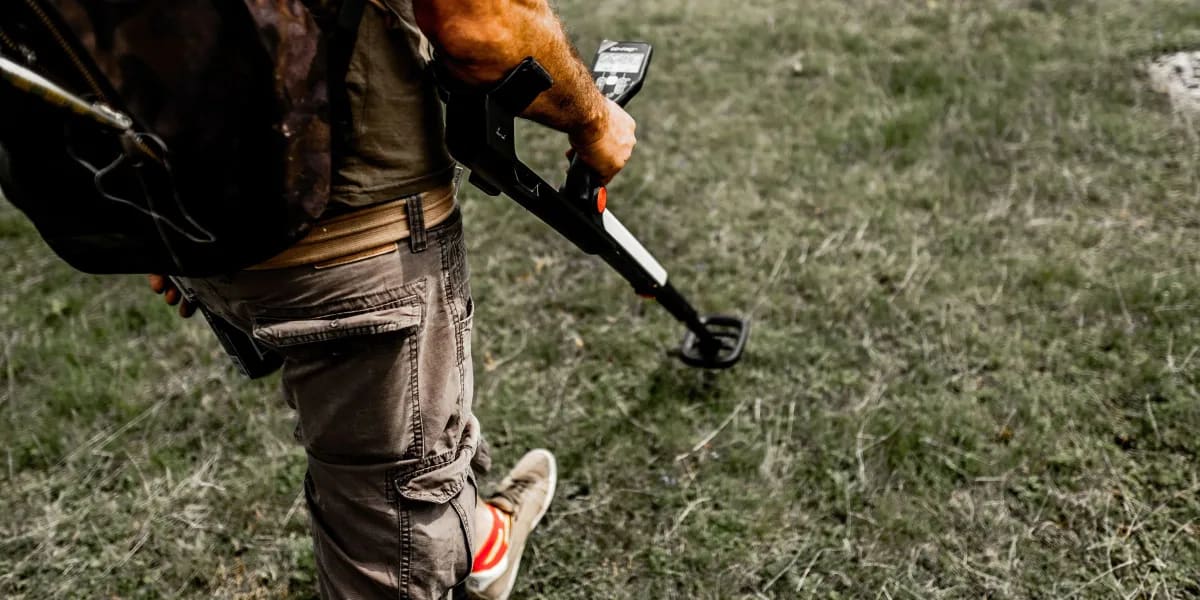
By the time my eight-year-old son shouted, "Mom! This one's different!" my husband had already warned him away from the shoreline four times.
That's why I followed Remy toward the old tree instead of telling him to keep searching somewhere else.
He swept the metal detector over the ground again.
"Mom! This one's different!"
Then came another long, sharp tone.
Remy's eyes widened. "That's treasure. I know it is."
I looked toward the lake house.
Tripp wasn't on the porch anymore.
"Hand me the shovel," I said.
Remy pulled it from his bucket but held on for a second. "It's my treasure, Mom. Okay?"
"And I'm the adult with digging privileges."
He let go. "You don't even like dirt."
"I like answers, honey. And I want to see what's buried here too."
That was more true than he knew.
I crouched beside the tree while Remy stayed next to me. The lake was several yards away through the branches.
I pushed the little shovel into the ground.
The screen door slammed behind us.
Then my husband shouted, "Don't dig there!"
Tripp was running toward us.
I'd known him for 12 years and had seen him furious, exhausted, and scared before.
I'd never seen him look like that.
The shovel struck something hard.
It was metal against metal.
My husband stopped a few feet away.
The color drained from his face.
Suddenly, I knew he'd never been worried about the shoreline.
A few weeks earlier, I'd bought Remy the metal detector for his birthday after months of hearing about "real treasure."
He loved those shows where people pulled coins, jewelry, and old objects from the ground.
Soon, every patch of dirt looked like hidden history.
When he opened the detector, he hugged me so hard my glasses went crooked.
A few weeks later, we drove to Tripp's family lake house for the weekend.
The place had been in his family for decades.
To Remy, that meant one thing.
"There has to be something buried here."
On Saturday morning, he swept the detector across the yard and treated every beep like a national emergency.
He found bottle caps, a bent spoon, an old fishing lure, and 73 cents by noon. He called the growing pile his museum.
Then Remy moved toward the shore.
"Buddy, stay up by the house."
I barely noticed the first warning.
By the fourth, Tripp had left the porch and crossed half the yard to redirect him.
"Good Lord, Tripp, he's fine."
"It's slippery down there, Serena."
"He's not even at the water."
"I don't want him searching there."
He glanced toward the tree.
"Can we not make everything into a big deal?"
"Questions usually become conversations. That's all, Tripp."
I watched the door close.
I'd grown up in a quiet house. My parents were polite right up until my father packed a suitcase when I was 14.
Afterward, relatives told me they'd been unhappy for years.
I'd lived inside those years without knowing.
So when I married Tripp, I promised myself I wouldn't mistake silence for peace.
Apparently, I needed reminding.
Now, beside the tree, I set the shovel down and brushed dirt away with my hands.
Across from us, Tripp didn't move.
Faded black marker ran across the top.
"FOR REMY - WHEN YOU'RE OLD ENOUGH."
I recognized my husband's handwriting.
"Why is our son's name on something you buried here?"
Tripp rubbed a hand over his mouth.
"Because he wasn't supposed to find it yet."
"Remy, go wash your hands."
"So I should get to open it."
"Not right now, Remy. Please."
"Because whatever's inside is something your dad and I need to talk about."
"Did Dad do something bad?"
That question changed my tone immediately.
"No. Nothing you need to worry about. Go inside, get a snack, and put your other finds on the table. I'll be there soon."
Then he nodded and headed inside.
I waited until the door shut.
Tripp's shoulders dropped.
"Open the box now, Tripp."
Some had dates. Others had Remy's name across the front.
I picked up the oldest one.
"Don't. Serena... please."
"You don't get to say that anymore."
"You don't understand what those are."
So I unfolded the letter.
I made it through one line.
"If your mom and I aren't living together when you're old enough to read this..."
"You don't understand what those are."
Two years ago had been ugly. We'd fought about money, work, parenting, and why every conversation left us tired and defensive.
I thought that meant we'd made it through together.
"You thought we were getting divorced."
"I thought we might, Serena."
"Did you talk to a lawyer?"
"Look for somewhere else to live?"
"I thought we might, Serena."
"My sister knew we were struggling."
"Enough to know how bad it got."
I folded the letter carefully.
"You were preparing our son for the end of our marriage while I was still asking you what you wanted for dinner."
"I didn't know how to talk to you. So I was preparing myself... and Remy, if he ever needed it."
"You could've started before you bought envelopes and buried them."
"You think I didn't try?"
I wanted to answer immediately.
Instead, I looked at the box.
"I can't do this right now."
"If I stay out here, I'm going to say something just to hurt you. That's not fair."
I carried the box inside.
An hour later, Remy was on the back steps sorting bottle caps into categories only he understood.
I sat at the table with the box.
I wanted the whole story, not just Tripp's version.
I sorted the envelopes by date.
The dates stretched from two years ago to 23 months ago, then 21 months, then 19.
Then I found one near the bottom.
Our worst period had ended long before that.
He appeared in the doorway.
"When were you planning to mention this?"
"It doesn't mean what you think."