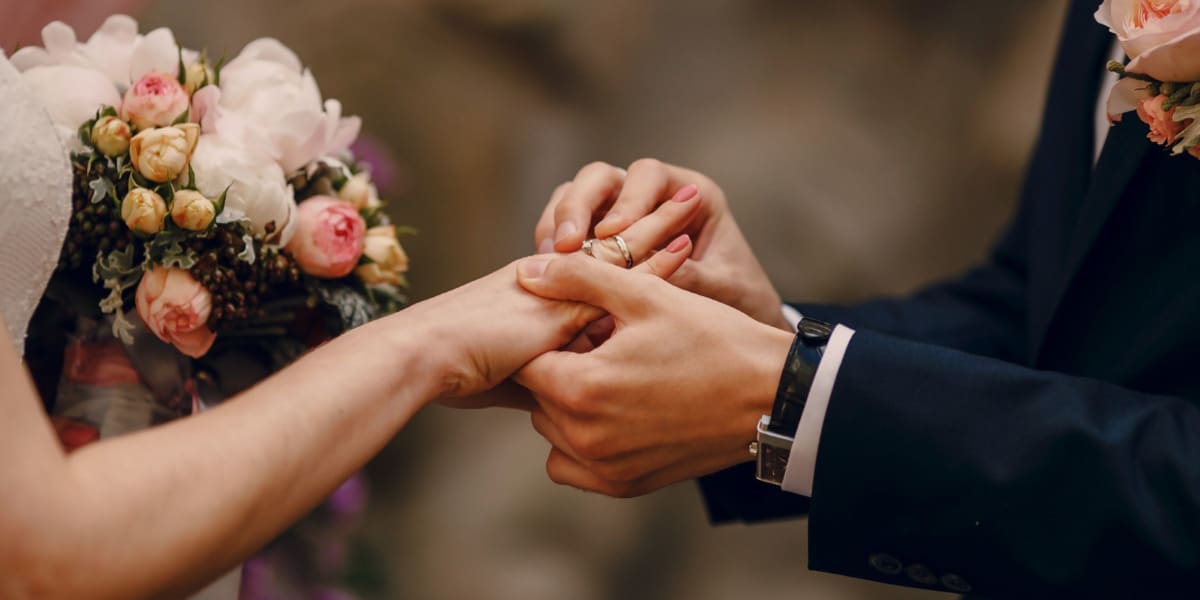
I married a dying man to honor his final wish. Ten days later, I stood beside his coffin holding the ring he had been too weak to place on my finger. That evening, his lawyer arrived with something Carl had forbidden him to give me while he was alive... something to haunt me for the rest of my life.
Three times a week, I volunteered with a hospice support program.
Most patients wanted ordinary help. A warm meal. Clean sheets. Someone to sit with them.
Carl wanted to play Scrabble.
He was 40, thin from treatment, and lived alone in a small house crowded with books. On my first visit, he pointed toward the game board before I had removed my coat.
"Do you know how to play?" he asked.
"Do you cheat?"
"Only when necessary."
He studied me for a moment.
"We'll get along fine," he said.
I brought soup, washed dishes, and made tea. Before long, Carl remembered everything I liked.
At first, I assumed he was observant.
Later, I realized he was remembering.
Carl had stage four cancer.
He never pretended the treatments were working. He simply disliked allowing illness to become the largest thing in the room.
When pain interrupted a conversation, he waited for it to pass, then picked up exactly where he had stopped.
Except once.
We were playing Scrabble when he tried to tell me about a teacher he had admired. His mouth opened, but the sentence would not come.
His illness had begun affecting his speech, and the harder he pushed, the more trapped the words became.
Carl gripped the edge of the table.
I looked toward the window.
"Did I tell you what happened at work yesterday?"
He shook his head.
I launched into a ridiculous story about a volunteer locking herself inside the supply closet. I added details until Carl's shoulders loosened.
By the time I finished, he was smiling.
"You did that on purpose," he said softly.
"Did what?"
He looked down at the board, a calculating stillness settling into his gaze.
"You distracted me."
A week later, I found him wearing a pressed blue shirt. A small velvet box sat beside his tea.
"Marry me, Selena," he said.
I nearly dropped the grocery bag.
He gave a tired smile.
"I know how that sounds."
"We have known each other four months."
"Four very competitive months," he corrected.
I did not laugh.
Carl folded his hands, and the humor left his face.
"I filled out hospital paperwork this morning. Every space marked 'next of kin' was blank." His fingers rested beside the velvet box. "I am asking whether my last chapter can have someone holding my hand."
I sat across from him.
"You deserve more than pity, Carl."
"Then why me?"
Carl looked toward the bookcase.
"Because you never make kindness feel like charity."
A quiet ache bloomed right behind my ribs.
I had spent years volunteering beside dying people. I knew the danger of confusing compassion with love.
But whatever I felt for Carl wasn't obligation. It felt like finding a familiar room in a house I'd never entered.
"All right," I said.
The next afternoon, a priest married us in Carl's living room. When Carl's hand shook too badly to place the ring on my finger, I guided it with mine.
He exhaled as though he had reached shore.
For 10 days, I was his wife.
I cooked while he directed me from a chair. We watched old movies. I read aloud when his eyes grew tired.
On the eighth night, I found him holding a worn novel against his chest.
The cover was faded beyond recognition.
"What book is that?" I asked.
"May I see?"
He squeezed the book against his chest like a shield.
I teased him for being secretive.
He smiled, but he did not hand it over.
Carl died two mornings later with my hand beneath his.
His final breath came so gently that I did not recognize it as an ending until the room remained still.
At the funeral, there were fewer than 20 people.
Most were Carl's friends and former students. One left a paper lunch bag beside the coffin. Another left a blue birdhouse.
I thought I had given a lonely man 10 days of belonging.
I didn't yet understand what he'd given me.
That evening, someone knocked on my door.
The man outside wore a charcoal coat and carried a leather case.
"Selena?"
"My name is Mr. Baron. I was Carl's lawyer."
I stepped aside.
He remained on the porch.
"When I met him a few days ago, Carl made me promise not to come back until after his funeral. I knew he didn't have much time left... but I never imagined that would be our last conversation."
Mr. Baron opened the case and removed a sealed envelope.
"He said you needed to grieve the man you knew before learning who he had been."
My fingers stiffened around the envelope.
Mr. Baron released a slow breath.
"He made me wait until today to tell you who he really was."
The letter inside was written in Carl's careful handwriting.
Selena,
Our meeting was not an accident.
Before I became your husband, I was the awkward guy who lived two houses down and spent every autumn hoping you would stop by Arthur's workshop.
My knees struck the floor.
Mr. Baron caught my elbow, but the letter slipped from my hand.
Two houses down.
Arthur's workshop.
A narrow alley.
The smell of sawdust and bicycle grease.
Memory opened so suddenly that I could not breathe.
"Silver Oak Street," I whispered.
Mr. Baron nodded.
I had lived there until I was 14.
Then my parents died in a car accident, and I entered foster care. Strangers packed our house while I sat in a county office clutching a trash bag of clothes.
I never returned.
"I knew a guy," I said. "Quiet. Dark hair."
"Carl," Mr. Baron muttered.
The denial came too quickly.
The Carl I remembered was the quiet young man who lived with his grandfather and repaired bicycles behind their house.
The man I married had laughed easily and argued over books.
Mr. Baron lowered himself into the chair across from me.
"Carl lost both parents when he was seven," he said. "Arthur raised him."
I remembered Arthur's cracked hands and gentle voice.
I remembered bringing him soup when he caught the flu because my mother said nobody should eat alone while sick.
Carl had stood behind the workshop door, watching.
Then small things returned.
Arthur's handmade birdhouses.
The smell of sawdust.
One Saturday afternoon at the workshop, an impatient customer confronted Carl about a bicycle. He opened his mouth to explain, but his stutter worsened.
The customer lost patience completely, yanked the bicycle out of Carl's grip, and marched out.
Carl disappeared behind the workshop before anyone could say another word.
I followed him.
He stood facing the back wall, his shoulders hunched, his breathing ragged.
I did not touch him.
I simply stood nearby until his breathing steadied, then I said softly, "That bicycle is beautiful. You should be proud."
He never turned around.
But his shoulders lowered slightly.
After that, I tried to find excuses to visit the workshop. I brought my bicycle in for repairs it didn't need. I asked Arthur questions about his work.
I was 14 and doing all the brave things I could manage.
Then one morning, my mother woke up with a headache.
My father drove her to the hospital.
Neither of them came home.
I was 14 and doing all the brave things I could manage.
My life fractured into before and after.
I forgot about the workshop.
I forgot about the quiet boy with dark hair.
I forgot about the workshop.
For 30 years, I did not think of Silver Oak Street.
Then one Tuesday, a hospice coordinator called with a new patient's name and address.
I went to that small house crowded with books.
I did not recognize him.
He did not say a word.
For 30 years, I did not think of Silver Oak Street.
But Carl had been watching that driveway through 30 winters.
According to Mr. Baron, Carl had found me several years earlier through a combination of old yearbooks and persistent detective work. He had documented my volunteer work at the hospice. He had learned about my patterns.
He had simply arranged to be sick at exactly the right time.
"He wanted to see you again," Mr. Baron said carefully. "He wrote about it extensively in his journal. When the diagnosis came, he said it was finally his chance."
According to Mr. Baron, Carl had found me several years earlier.
My vision blurred.
"He married me because I was convenient. Because he was dying and lonely and—"
"He married you," Mr. Baron interrupted quietly, "because he loved you for 30 years."
Something shattered inside my chest.
"I didn't even know him."
"He knew you," Mr. Baron said. "He knew you brought soup to his grandfather. He knew you tried to comfort him without making it strange. He knew you left your bicycle for him to fix one last time before you disappeared from his life forever."
The notebook.
The worn book he had pressed against his chest.
The notebook.
I did not open it for three weeks.
When I finally did, I found entries in Carl's handwriting spanning decades.
Some pages were brief. Others filled front and back with tiny script.
Selena rode her bike past the workshop today wearing a yellow backpack. She is still brave.
Selena's father is dead. I saw it in her face before she even left my grandfather's house. She looked for a moment like she might ask me for help. I would have given everything.
I saw Selena in the grocery store. She did not see me. She was laughing. It was the most beautiful thing I have ever seen.
I did not open it for three weeks.
Thirty years of longing documented in careful script.
Thirty years of a man loving a girl he barely knew, then a woman he could never reach.
Thirty years of an impossible ache.
The last entry was dated the week before he called the hospice coordinator.
Selena, I will never be brave enough to tell you who I am while I am alive. I will be dead soon. After I die, when you know who I was, I hope you will remember that boy who fixed bicycles and thought you were brave.
I hope you will forgive me for loving you like this.
The last entry was dated the week before he called the hospice coordinator.
I could not decide which was worse.
That he had lied to me through ten days of marriage.
Or that every single moment was the truest thing he could manage.
I could not decide which was worse.
I wept in a way I had not allowed myself since I was 14 years old.
I wept for the boy behind the workshop door.
I wept for a man who spent 30 years watching the life of a girl he loved from an impossible distance.
I wept because our love story existed in the spaces between longing and loss.
I wept for the boy behind the workshop door.
I keep his journal on my nightstand now.
Sometimes I read entries from the middle years when I am struggling, when the guilt threatens to consume me.
I find myself returning again and again to a passage where Carl wrote about the day I visited the workshop and distracted him from his pain.
I had been so afraid to touch him.
But I had found another way to say: You are not alone.
Carl had spent his whole life waiting for that moment.
When he finally died, he was holding someone's hand.
I keep his journal on my nightstand now.
On difficult mornings, I read those words and I understand.
I was not kind to Carl because I was settling for a dying man.
I was not patient with Carl because I pitied him.
I chose Carl every single day because something in me recognized something in him.
A boy who had watched from behind the workshop door.
A girl who had brought soup to a lonely man.
Two lonely people who never quite knew how to speak to each other.
Until Carl found a way that did not require words at all.