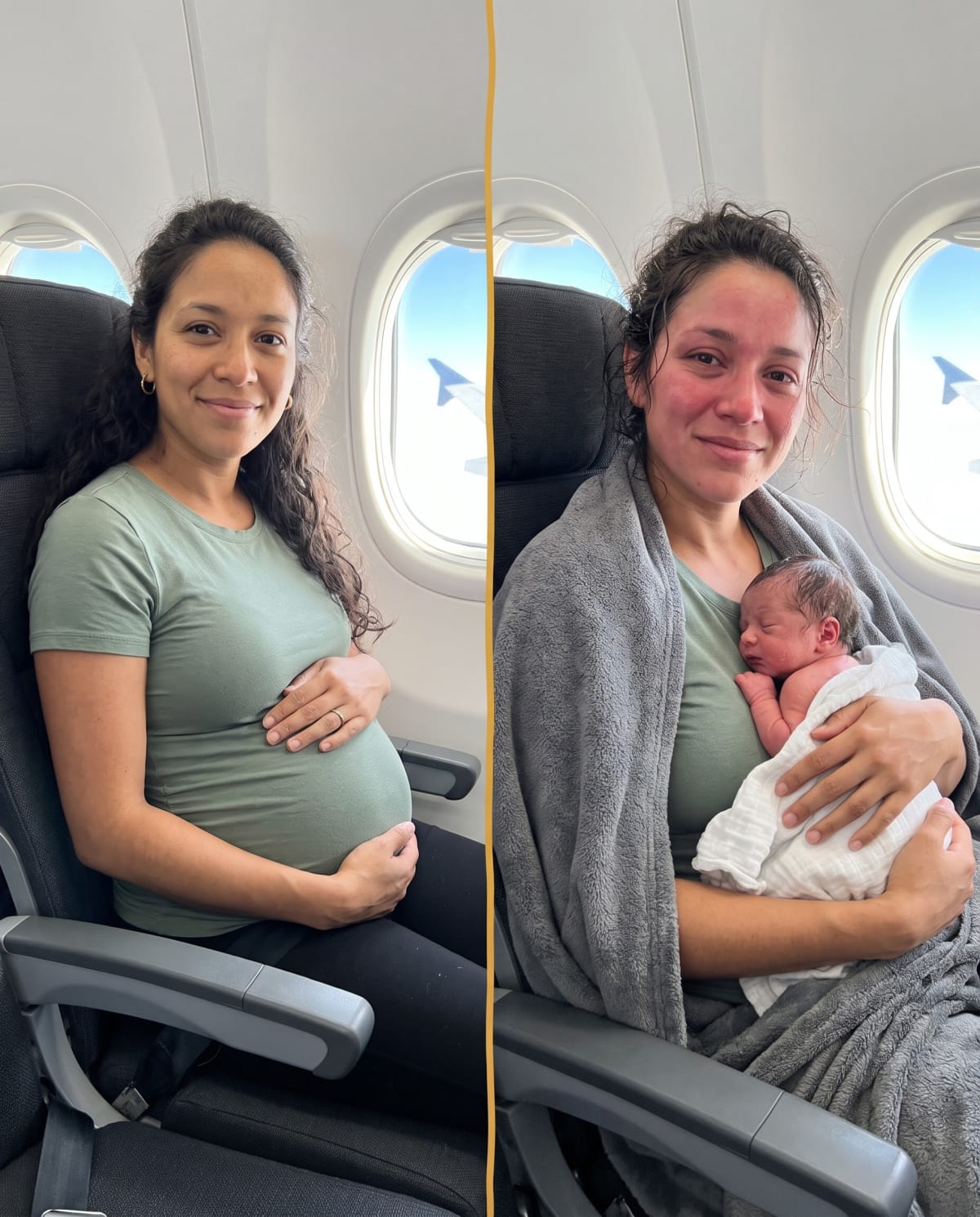
I still can't believe I'm writing this, but I need to share what happened because the whole thing feels unreal.
When I was 34 weeks pregnant, my dad had a massive heart attack.
The doctors weren't sure he'd make it, and I was an absolute wreck.
I knew stress was the last thing I needed that far into my pregnancy, but there was no way I could just sit at home. I'd never forgive myself if something happened to Dad and I didn't get to see him.
So my husband and I flew out to be with him.
Thank God, he pulled through! After a few days, we were finally heading home, where I planned to rest and get ready for the baby.
My doctor had cleared me to fly, and my pregnancy had been going smoothly, so I figured we'd be fine.
Boy, was I wrong.
About an hour into our flight, I started feeling sick. Then came the contractions, and they were getting stronger fast.
My husband called a flight attendant, who immediately asked over the intercom if there were any medical professionals on board.
A man named Ramon, who was a paramedic, came over to help.
So imagine my reaction when he said, "Ma'am, I think you're in labor."
What?! I still had six weeks to go!
The pilots arranged an emergency landing, but apparently, my daughter had other plans.
Everything after that was a blur. Ramon helped deliver the baby while my husband held my hand, looking like he might pass out himself.
And just like that, our little girl was born at 35,000 feet.
She was tiny but perfect, and I remember crying and laughing at the same time.
The flight attendants wrapped her in blankets and got me as comfortable as they could in seat 12C.
We were told we'd be landing in Denver in about twenty minutes.
I was exhausted but exhilarated, just staring at this tiny human I'd just brought into the world in the most unusual way possible.
My husband kept kissing both of us, tears streaming down his face.
"We have a daughter," he kept saying. "We have a daughter."
Ramon stayed nearby, monitoring both the baby and me, making sure everything was stable for the landing.
He was incredible—calm, professional, but also genuinely warm and supportive.
I felt so grateful for him and for the flight crew, who had handled the whole thing like absolute pros.
Then, as we were getting ready to land, the captain came over the speakers.
At first, it sounded like a routine landing announcement.
But then he said something that immediately made me nervous.
"Ladies and gentlemen, we're beginning our descent into Denver. On behalf of the entire crew, we want to congratulate the parents of our newest passenger born today at 35,000 feet."
The cabin erupted in applause and cheers.
I felt my face go red, but I was smiling too.
Then the captain's voice came back.
"However, there's something important the mother needs to know before we open the doors."
My stomach dropped.
Was something wrong with the baby? Had the paramedic missed something?
I looked at Ramon, who looked just as confused as I felt.
The captain continued.
"During the delivery, we had our aircraft's camera system running as a precaution. The footage is being live-streamed right now on every major news outlet in the country."
I felt the color drain from my face.
"What?" I whispered.
My husband grabbed my hand.
"That can't be right," he said to no one in particular.
The captain wasn't done.
"Your story is going viral as we speak. When we land, there will be media waiting at the gate. We recommend you prepare yourselves."
I looked down at my newborn daughter, then at my husband, then back out at the rows of passengers who were now all looking at me.
Some were smiling. Some were recording on their phones.
My privacy—something I'd never given much thought to before—had just evaporated at 35,000 feet.
Ramon put a gentle hand on my shoulder.
"The important thing is that you and your baby are healthy," he said quietly.
He was right, of course, but my mind was already spiraling.
I'd just given birth to my daughter in the most dramatic way possible, and now the entire world was about to know about it.
The landing itself was uneventful, which felt strange given everything else that had happened.
As we taxied to the gate, I could see through the window that there were indeed news vans lined up.
My husband squeezed my hand.
"We can do this," he said. "We're a family now. That's all that matters."
He was right, but I still felt terrified.
When the cabin door opened, one of the flight attendants came over with a wheelchair for me.
"We're going to get you to the hospital first," she said gently. "The captain arranged for you to exit through a private door away from the media."
I was so relieved I could have cried—again.
As we wheeled through the airport, I could see news crews being kept behind barriers.
Cameras flashed and reporters shouted questions, but we were moving too quickly for them to get close.
At the hospital, the doctors checked us both over thoroughly.
My daughter was perfectly healthy, just early.
They said she was likely induced into labor by the stress of flying and my father's illness, but that she was strong and doing great.
That night, in my hospital room, I finally had a moment to process everything.
My husband was asleep in the chair next to me, and my daughter was sleeping in the bassinet beside my bed.
I picked up my phone, against my better judgment, and looked at what was trending.
#PlaneBaby was the number one hashtag worldwide.
There were articles, videos, think pieces about the miracle of birth, the dedication of the paramedic, the professionalism of the flight crew.
But there were also invasive comments, conspiracy theories, people analyzing every detail.
I put the phone down and just looked at my daughter.
She didn't know any of this was happening.
She didn't care about the attention or the headlines.
She just existed, perfect and innocent.
That's what I needed to focus on.
Over the next few days, more details emerged about what had happened.
Apparently, the camera footage wasn't actually live-streamed—the captain was exaggerating to prepare me for what would happen once we landed.
But he was right; the story had spread like wildfire.
Ramon had given an interview to a local news station, and his calm, modest description of the birth only made him more of a hero in people's eyes.
The airline reached out and wanted to do a big publicity thing, but we politely declined.
All we wanted was to go home and be a normal family.
Two days later, we were discharged from the hospital.
The media was still outside, so the hospital arranged for us to leave through a back entrance.
As we were loading into our car, I caught sight of Ramon in the parking lot.
He was there saying goodbye to his family, who had come to pick him up.
I asked my husband to wait a moment.
"Ramon!" I called out.
He turned and smiled when he saw us.
I wheeled over to him with the baby.
"I just wanted to say thank you," I said. "Really, truly, from the bottom of my heart."
He reached out and gently touched the baby's forehead.
"She's beautiful," he said. "You did great."
"You did great," I replied. "I don't know what we would have done without you."
We hugged, and then my family and I headed home.
For the next month, I had to adjust to being someone people recognized.
Strangers would approach me in the grocery store with congratulations and well-wishes.
Some people were sweet and genuine. Others just wanted a photo or a story they could tell.
My daughter, who we named Sofia, had no idea she was famous.
She just ate and slept and cried like any other newborn.
And honestly, watching my husband with her, seeing how protective and loving he was, made me forget about all the noise.
The attention eventually died down as the news cycle moved on to other stories.
But I'll never forget what happened that day.
Not just the birth itself, but the whole experience—the fear, the confusion, the support from strangers who became heroes in that moment.
Sometimes I still can't believe Sofia was born on a plane.
It feels like something that happened to someone else, not to me.
But then I look at her—she's three now, with her dad's eyes and a wild spirit that definitely showed up early—and I'm reminded that it really did happen.
That day changed my life in ways I never could have predicted.
Not just because I became a mother, but because I learned that the world is full of good people.
People like Ramon, like the flight crew, like the captain who prepared me for what was coming.
I think about what it means that my daughter's first moments on earth were witnessed by hundreds of people, broadcast to millions more.
I used to feel a little strange about that.
But now I see it differently.
Her arrival was a moment of joy for so many people during uncertain times.
In a weird way, that feels like a beautiful thing.
My dad recovered fully, by the way.
He was devastated when he found out he missed Sofia's birth while recovering in the ICU, but he's made up for it with an embarrassing amount of grandfather love.
Sometimes he'll randomly bring up the news coverage and laugh about his granddaughter being born in the sky.
As for Ramon, he reached out about a year later to see how Sofia was doing.
We've stayed in touch, and he's become an honorary uncle of sorts.
He comes to her birthday parties and spoils her rotten.
I never thought I'd have such a personal connection with the person who delivered my baby, but life is full of surprises.
The most important thing is that we're all healthy and happy.
Sofia asks sometimes about being born on a plane, and I tell her she was always someone special.
Maybe it's fitting that her entrance into the world was as dramatic and unforgettable as she is.