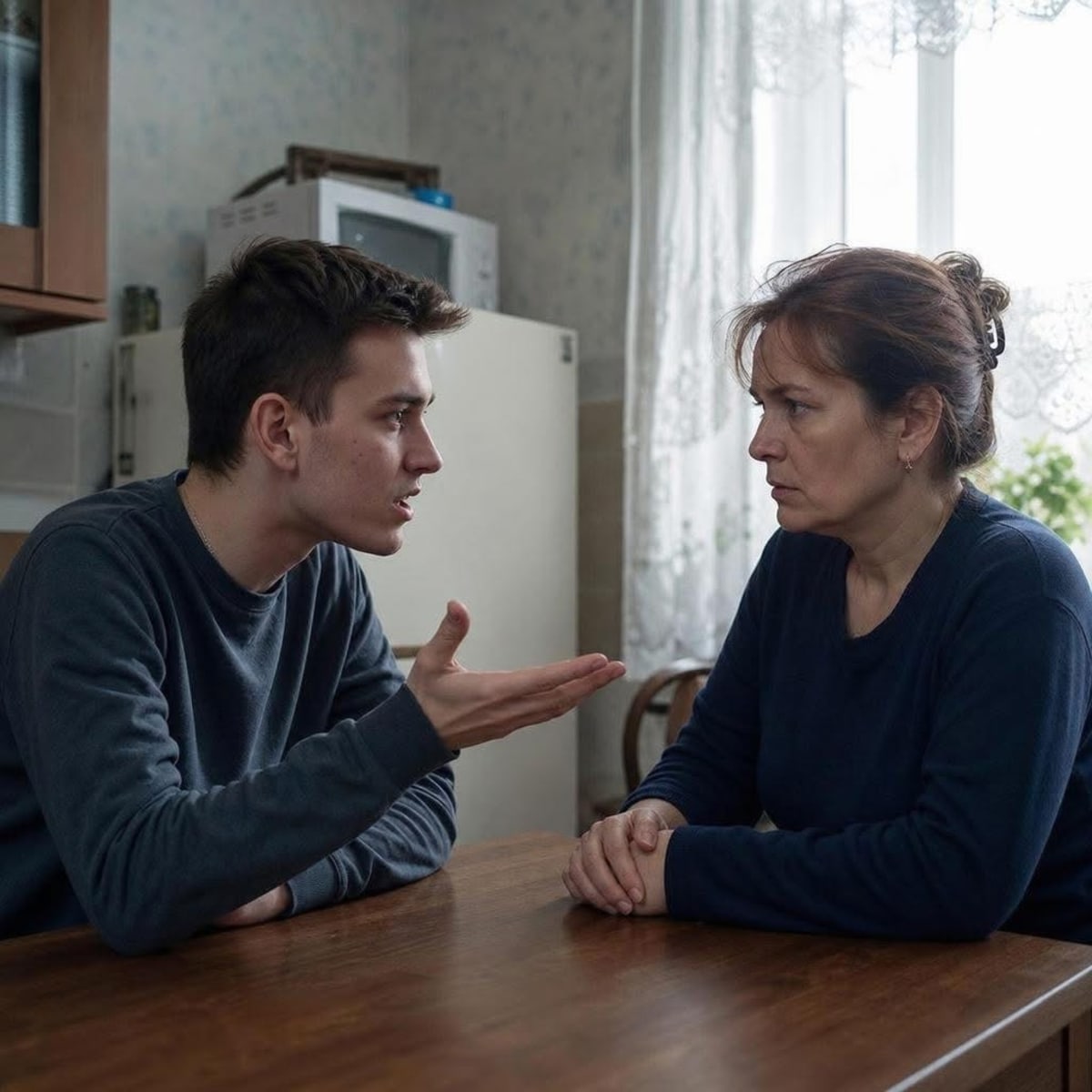
"Pack your things," the lieutenant said wearily, looking at my son. "Since your mother poses a threat to you and treats you cruelly, you'll go to the distribution center. Until we sort out the circumstances."
Matvey sat on the couch in his room. A minute before this, he had been carefully squeezing out tears and rubbing his reddened shoulder, telling the juvenile inspector how I terrorize him.
But when he heard the word "distribution center," his face suddenly stretched. He abruptly stopped whimpering and shot me a quick, bewildered glance.
He was expecting me to throw myself at the police officers' feet. To start sobbing, begging them not to take my precious boy, swearing that I'm a good mother, and in compensation for moral damages, immediately promise my son that very new iPhone that had actually sparked this whole spectacle in the first place.
But I stood, leaning my shoulder against the doorframe, and silently watched him. Inside was absolute emptiness. Neither fear nor pity. Only the cold, ringing exhaustion of a person who had finally understood: this cannot continue.
"Go on, Matvey, pack your backpack," I said calmly. "Take a towel, your toothbrush. And a change of underwear."
His eyes widened. The spectacle wasn't going according to script.
***
It didn't start yesterday. I suppose I missed the moment when my child, with whom we once baked pancakes together on weekends and watched movies, turned into a cold, calculating consumer.
I raised him alone from the age of ten. My ex-husband, Matvey's father, quickly removed himself into a new family after the divorce, limiting himself to child support that was just enough to pay for school lunches and swimming lessons. I bore all the financial burdens alone—the mortgage and household expenses. I worked as a chief accountant at a small logistics company, took side jobs from home, balanced other people's accounts through the nights, so my son would want for nothing.
I thought that was love—to give him what I never had in my childhood. A good computer, expensive sneakers, brand-name hoodies. I excused his laziness as adolescence. I blamed his rudeness on hormones. I swallowed insults, thinking: "Well, he's a teenager, he's struggling, I need to be wiser."
Red flags started sounding about six months ago, when Matvey turned fifteen.
He stopped asking. He started demanding.
At first it was small things.
"Mom, send me two thousand rubles to my card, we're going to the burger place with the guys."
"Son, I gave you pocket money yesterday," I tried to say gently. "Everything's allocated until my paycheck, the mortgage payment is due."
"Well, borrow from someone," he said carelessly, not even looking up from his smartphone screen. "You're my mother, you should support me. All the guys have decent money, I'm the only one like a beggar."
I sighed, felt a pang of guilt, and transferred the money.
Then his appetite grew. Matvey decided he vitally needed a new gaming computer. The old one was only two years old, but it "couldn't handle the graphics." When I refused, citing the fact that one hundred fifty thousand rubles was a sum we couldn't afford, my son threw a tantrum.
He didn't yell. He just stopped talking to me. He ignored my questions, slammed doors in my face, demonstratively left piles of dirty dishes on the kitchen table, knowing I'd come home exhausted from work.
I endured it. I tried to have heart-to-heart talks with him, sat on the edge of his bed, told him about our budget, about how difficult things were for me.
"That's your problem," he answered coldly once. "You shouldn't have given birth to me if you don't have money. The state actually protects teenagers' rights. I have the right to a decent standard of living. I read about it on the internet."
That's when I first felt a chill of fear. Before me sat a stranger speaking to me in the language of legal threats from cheap TikToks.
***
The final straw came three weeks ago.
I came home two hours early—the meeting was cancelled. The hallway was quiet, only muffled voices coming from Matvey's room. He was playing some online team game and chatting with friends over a microphone.
I took off my shoes and headed to the kitchen with heavy shopping bags, but stopped halfway. His door was slightly ajar.
"Yeah, this old hag's completely lost her mind," my son's voice boomed confidently. "Can you believe she wouldn't buy me new Jordans? Says she has a mortgage. I don't give a damn about her mortgage. I told her straight up: if you don't buy them, I'll make your life so miserable you'll regret it. You have to support me until I turn eighteen. You can't go anywhere, you'll just cry and buy them. She always caves."
I stood in the hallway with a shopping bag in my hands, a loaf of bread and a milk carton sticking out of it. My fingers gripping the handles went white.
"Old hag." "Always caves." "Can't go anywhere."
I didn't feel anger or indignation. There was only complete emptiness and the heavy realization that all my efforts over the past fifteen years had been meaningless. I walked quietly to the kitchen, set the bag on the table. Unpacked the groceries. Sat on a stool and stared out the window for about an hour.
I didn't make a scene that evening.
I simply made a decision.
***
The next morning, while Matvey slept, I went into my bank app and blocked the attached card to which I transferred money daily for his expenses. On the kitchen table I left two hundred rubles in cash—just enough for a school lunch and bus fare. Then I went to work.
Around lunch, my phone started ringing nonstop.
"What's this about?" Matvey angrily yelled when I answered. "Where's the money on the card? I'm standing in a café!"
"The money's on the table," I said calmly. "Two hundred rubles. That'll cover food in the school cafeteria."
"Are you messing with me?! What two hundred rubles? Unblock the card right now!"
"The card is blocked. Your basic needs for food and shelter are provided. Everything else is a luxury that I, as an 'old hag and pushover,' have no intention of paying for anymore."
Silence hung on the other end of the line. He understood that I'd heard everything.
Then came short dial tones.
That evening, he gave me a frosty reception at home. Matvey sat in the kitchen with his arms crossed on his chest.
"Eavesdropping on other people's conversations is a violation of personal boundaries," he announced from the doorway, trying to seize the initiative.
"Living at someone else's expense and insulting the person who feeds you is impudence," I answered, taking off my coat. "Everything changes starting today, Matvey. No more pocket money for cafés, no more brand-name clothes. You have clean clothes, a bed, and food in the refrigerator. My obligations under the law end there."
He jumped up, knocking over a stool.
"You don't have the right! I'll make you pay anyway!"
Two days later, heavy artillery entered the conflict—my ex-mother-in-law, Zinaida Ivanovna. She only ever appeared when she needed to lecture me, even though she saw her grandson once every six months.
"Lenochka, what's going on with you?" her voice on the phone dripped with false sympathy. "Motechka called, he was crying. He says you're starving him. Why are you traumatizing the boy? It's adolescence, a boy needs understanding, and you've created a concentration camp over some silly joke!"
"Zinaida Ivanovna," I said, rubbing my temples tiredly. "Motechka is fifteen. He calls me an old hag and demands expensive sneakers. If you feel so sorry for him, take him to live with you. Then you can provide him with 'understanding' and brand-name shoes."
"How can you say such things!" she immediately protested. "I have high blood pressure, I'm getting old! Besides, he's your son, you're his mother, you have to be patient! We're family, we have to know how to forgive!"
"That's exactly it—this is my family," I cut her off. "And I set the rules in it."
I hung up. Double standards were always her strong suit. "We're family," as long as it doesn't come to real responsibility.
Matvey understood that grandma wouldn't help. And then he took extreme measures.
***
It happened on Friday evening. I came home after a quarterly report meeting, dreaming only of a shower and bed. Matvey blocked my way in the hallway.
"I need thirty thousand," he announced. "We're renting a cottage outside the city with the guys for the weekend, celebrating Vlad's birthday. We're splitting the cost."
"No," I tried to get around him.
"What do you mean no?! I already promised!"
"Cancel the promise. I don't have that kind of money for your parties. And even if I did, I wouldn't give it to you."
He turned pale with rage.
"So that's it?" he stepped closer to me. "You think I'm joking? You think you're in charge here? I read on the internet. If I call the police and say you're beating me, using psychological violence, and starving me—you'll lose parental rights. They'll take me, and the state will pay me benefits. And I'll live great in a normal foster family or in a children's home with more freedom than with you!"
I looked up at him. My son. My blood. A person I lost sleep over for nights. He stood there with the cynical, confident smirk of a petty blackmailer.
"You won't dare," I said quietly.
"Wanna bet?" he pulled out his phone. "Come on, transfer the money. Or I'm calling 112."
I was silent. I simply couldn't believe he was capable of crossing that line.
Matvey took my silence for weakness. He suddenly swung hard and hit his own shoulder against the doorframe. Hard. He gasped as the wind was knocked out of him. Then he grabbed my favorite ceramic vase from the side table and smashed it on the floor. The vase shattered into pieces.
He dialed a number. Put it on speaker.
"Police?" his voice instantly changed. It became thin, trembling, full of tears. "Help me, please… My mom… she's drunk, she's throwing things and beat me… I'm really scared!"
He gave our address and ended the call.
Then looked at me. The tears vanished, that same smirk returned to his lips.
"Well, that's it. You have about fifteen minutes to transfer me fifty thousand. For moral damages. Otherwise, when they get here, I'll show them the bruise on my shoulder and the broken pieces. You know who they'll believe."
Something inside me broke completely in that moment. And simultaneously—everything fell into place.
I went to the kitchen. Poured myself a glass of water. Drank it.
Sat down at the table and waited.
Matvey walked back and forth in the hallway, occasionally glancing into the kitchen. He started getting nervous. My calmness clearly wasn't part of his plan.
"Don't you get it?" he threw at me. "The guardianship office will be here soon. They'll strip you of custody!"
"We'll see," I answered.
They arrived twenty minutes later. Two police officers—an older lieutenant and a young female sergeant. With them, apparently per protocol for such calls, came a duty officer from social services.
As soon as the door opened, Matvey switched on his actor mode. He pressed himself against the wall, grabbed his shoulder, and began to whimper.
"She… she demanded that I get out of the house! And when I said I had nowhere to go, she threw the vase! And then she pushed me into the door!"
The police officers looked at me. I stood in the middle of the hallway in a strict office suit, completely sober, calm, and exhausted.
"Is that true?" the lieutenant frowned.
"No," I answered. "He hit himself against the doorframe and broke the vase himself."
"She's lying! She always does this and then acts normal!" Matvey shrieked hysterically. "Take me away from here, I'm scared to stay with her! I read, you have the right to take me to a safe place!"
The lieutenant sighed heavily, took out a tablet for the report. The guardianship officer looked sympathetically at Matvey, then sternly at me.
"Do you understand that these are serious accusations? If a minor refuses to stay with his mother and claims his life is in danger, we're obligated to remove him from the family and place him in a social rehabilitation center until all circumstances are clarified. Is that what you want? You understand what this could mean for you as a mother? Registration with us, inspections, possible court proceedings?"
Matvey stopped whimpering and glanced at me sideways.
In his eyes I could read triumph: "Well come on, pushover. Beg them. Beg me. Pay."
I shifted my gaze from the inspector to my son.
I remembered every unpaid bill so I could buy him a fashionable jacket. Every night with other people's accounts. Every "old hag," whispered into that microphone.
"I confirm what my son said," I announced loudly and clearly into the silence.
The lieutenant looked up from the tablet. The guardianship officer blinked in surprise. Matvey froze.
"What do you confirm?" the policeman didn't understand.
"That I cannot guarantee his safety. Or my own either. My son is out of control, showing aggression, blackmailing me with false reports, and demanding money. I can't handle his upbringing. And since he's officially claiming that life with me is a threat to him, I'm asking you to act according to the law."
I stepped toward the guardianship officer:
"Process the removal. Take him to the shelter."
The silence in the hallway became palpable.
"Mom… what are you saying?" Matvey's voice suddenly lost all its theatricality. Real, animal fear came through in it.
"Pack your things," the lieutenant said, understanding everything. He was an experienced man and clearly had seen such "victims" before. "Since your mother poses a threat, you'll go to the distribution center."
Matvey went pale. He stood and looked back and forth between me and the uniformed officers.
"Actually, I was joking!" he suddenly yelled. "Nobody beat me up! I hit myself! I just wanted her to give me money! I don't want to go anywhere!"
"You don't joke with police, kid," the young sergeant said harshly. "The call is logged. A report of violence was made. Now we have to take you, and juvenile inspectors will sort it out. Go get your backpack."
"Mom!" Matvey rushed at me, grabbed my hand. "Mommy, tell them! Come on, tell them everything's fine! I don't want to go to a children's home! Please!"
I looked into his eyes, full of genuine terror. It hurt. It hurt terribly. Any mother in that moment would have wanted to hug her child, say: "Excuse me, officer, the kid's an idiot, we'll handle it ourselves."
But I knew: if I backed down now, he'd understand I could be broken into submission. That there were no boundaries. That I would always give in.
I carefully, but firmly, pulled his fingers from my sleeve.
"I won't stop you, Matvey," I said quietly. "You wanted freedom from an old hag? You got it. Go pack your things."
Half an hour later, the door closed behind him.
I was left alone in an empty apartment. Ceramic vase pieces lay scattered on the floor. I got a broom, swept them into a dustpan, and threw them in the trash. Then I went to the bathroom, turned on the water, sat on the edge of the tub, and burst into tears. I cried like I hadn't cried even at my husband's funeral. I was mourning my little boy who no longer existed, and mourning that cruel teenager I had raised with my own accommodatingness.
***
The next morning hell began.
The guardianship office called, inviting me for a meeting. The school called because on Monday they received a police inquiry.
And that evening my ex-mother-in-law called.
"Lena!" she shrieked into the phone so loudly I had to move it away from my ear. "You're a monster! Matvey called me from the shelter! He got one call! How could you turn your own blood over to a children's home?! Are you a mother or a viper?! Go get him right now!"
"Zinaida Ivanovna," I answered calmly. "Matvey himself called the police and said I was beating him. I didn't hand him over, I agreed with his statement."
"He's just a child! He just wanted attention! How could you let a boy sleep on a state cot?!"
"If you're so worried, Zinaida Ivanovna, you can go to the guardianship office and